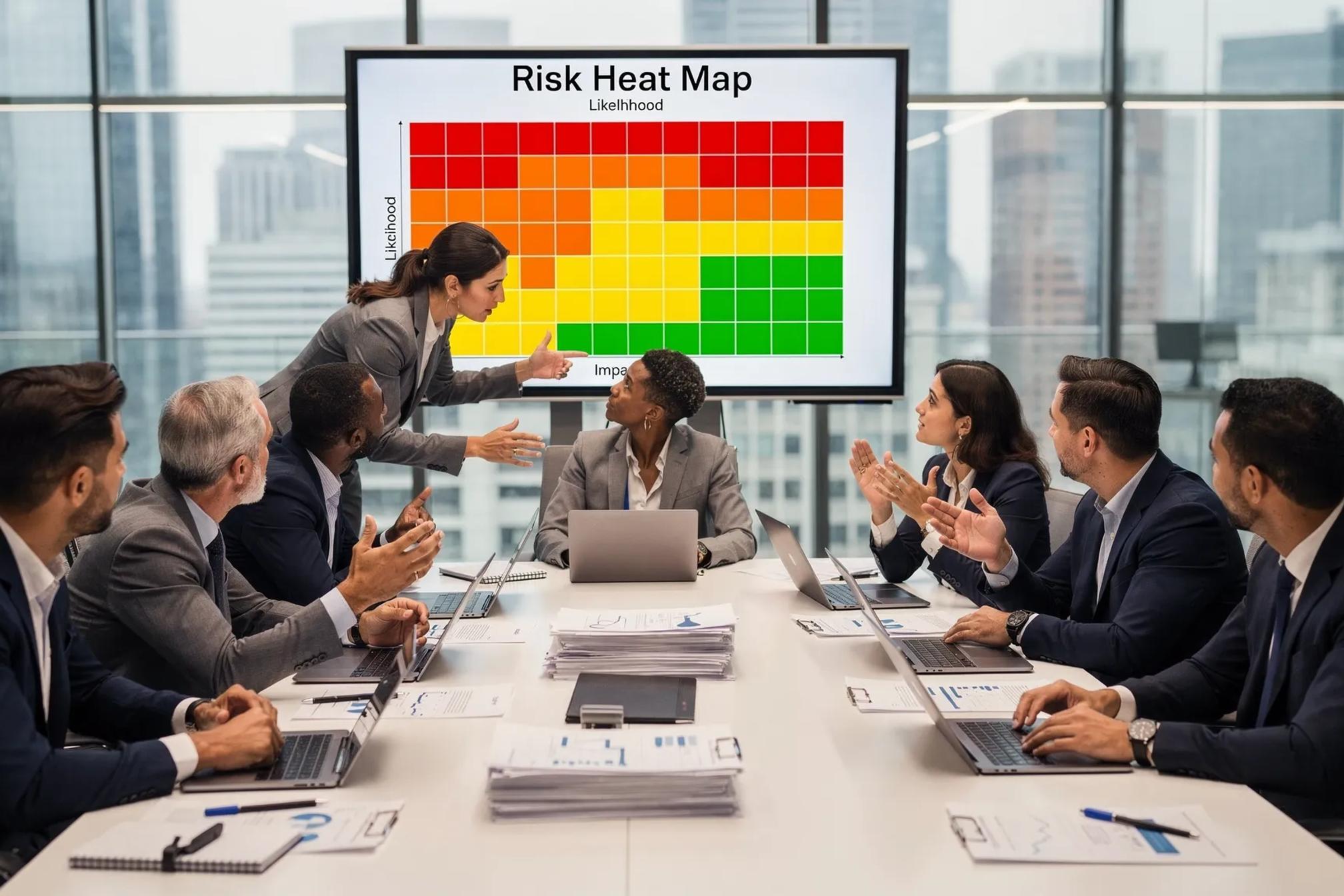
Most bribery risk maps fail in a predictable way: they look complete, but they do not explain how bribery could realistically happen in your workflows, and they do not produce evidence that your controls actually operate.
If you are working under France’s loi Sapin II expectations (and often the AFA’s audit approach), or aligning with ISO 37001, your risk map is not a slide deck. It is the backbone that should drive proportionate controls, targeted training, third-party due diligence depth, monitoring priorities, and board reporting.
This guide focuses on 7 risk-based blind spots that quietly weaken bribery risk maps, plus fast fixes you can implement without restarting from scratch.
What a bribery risk map must do (and what reviewers test)
A bribery (anti-corruption) risk map is meant to answer, in a defensible way:
- where bribery could occur (entities, countries, business processes)
- how it could occur (scenarios, triggers, actors, third parties)
- why it could occur (incentives, discretion, weak oversight, market pressure)
- what you do about it (controls, owners, evidence, residual risk, action plan)
Under loi Sapin II (article 17), risk mapping is one of the required components for in-scope companies, and it is assessed as part of an overall anti-corruption program.
For implementation expectations in France, the AFA’s recommendations are a practical reference point for what “usable” looks like in audits, especially around methodology, rationale, and traceability. Start with the AFA resources page: Agence française anticorruption.
On the standards side, ISO 37001 requires organizations to determine and assess bribery risks and maintain an anti-bribery management system that is risk-based. See the standard overview at ISO 37001. (ISO 37301 is a broader compliance management system, useful as a supporting structure.)
The key operational point: you cannot build a credible bribery risk map from documents alone. The highest-risk exposure typically sits inside day-to-day workflows (tenders, sales negotiation pressure, intermediaries, customs clearance, permits, gifts and hospitality). If you do not map those workflows, you will miss the pressure points.

A 10-step backbone you can use as your audit trail
Even if your immediate goal is “fix fast,” it helps to anchor your workplan to a simple, standards-aligned backbone.
Step | Output you should be able to show in an audit |
|---|---|
1 | Scope statement (entities, geographies, activities, objectives) |
2 | Governance and workplan (sponsor, team, calendar, confidentiality rules) |
3 | Documented inputs (internal data sources, external context) |
4 | Interview/workshop notes mapped to real processes |
5 | Scenario library (“how bribery could occur”) |
6 | Inherent risk scoring method (likelihood and impact definitions) |
7 | Control mapping and residual risk logic (based on operating controls) |
8 | Prioritized mitigation plan with owners, deadlines, evidence |
9 | Validation and approval record (rationale for rankings) |
10 | Review triggers and monitoring signals (minimum annual refresh) |
If your current map cannot produce these elements your blind spots are usually the following.
Blind spot 1: The scope is fuzzy (so the map becomes non-comparable)
What it looks like
- “Europe” is in scope, but nobody can list which legal entities and which business lines.
- JVs, agents, and recently acquired entities are “to be reviewed later.”
- The map mixes bribery risks with every other compliance topic without stating the objective.
Why it matters in building a risk-based anti-bribery program
A risk-based approach starts with boundaries. If scope is unclear, the map cannot support resource allocation, and comparisons across countries become arbitrary.
Fast fix
Create a one-page scope block and attach it to the risk map (and to the workshop invite):
- Entities in scope (legal entity list or clear inclusion rule)
- Geographies in scope (and what “operating in” means)
- Activities in scope (sales, procurement, logistics/customs, licensing/permitting, public tenders, M&A, sponsorships/donations)
- Objective (AFA readiness, ISO 37001 certification, integration after M&A, internal governance)
- Explicit exclusions (and when you will cover them)
This single page often resolves weeks of back-and-forth later.
Blind spot 2: The map is built from documents, not from workflows
What it looks like
- Beautiful heat map, but it is based on policy documents, not on how deals are actually closed.
- “Third parties” is a risk category, but there is no link to who uses them, when, and why.
- The map cannot explain where bribery pressure appears (targets, exceptions, urgency, discretion).
Why it matters in building a risk-based anti-bribery program
Bribery risk is situational. It concentrates where you have a combination of pressure + discretion + weak oversight, often intensified by intermediaries and public-official touchpoints.
Fast fix: run a targeted interview sprint (2 weeks)
Do not try to interview everyone. Focus on roles that sit on bribery pressure points.
Minimum interview set:
- Sales leaders and key account managers (especially public sector-facing)
- Procurement/category managers
- Finance (AP, controllers, treasury)
- Operations/logistics (customs, import/export)
- Licensing/permitting owners and government relations (if applicable)
- HR (incentives, disciplinary process)
- Country managers in higher-risk geographies
Use a consistent interview script so you can evidence your method:
- Interview question examples (bribery risk mapping):
- Walk me through a recent deal/tender from lead to payment.
- Where do we interact with public officials (directly or indirectly)?
- Where do we use third parties to “open doors”? Which ones?
- Where are targets tight and discretion high?
- What exceptions happen in practice (urgency, missing docs, side letters)?
- What is the most common rationalization you hear for gray-zone behavior?
- What would you change tomorrow to make the process safer without slowing it down?
The output you want is not opinions. It is a process list with decision points.
Blind spot 3: Risks are described as labels, not as scenarios
What it looks like
- “Corruption risk” or “bribery risk” appears as a generic line item.
- High risk is assigned because a country is “high risk,” without linking to concrete transactions.
Why it matters in building a risk-based anti-bribery program
Controls and testing are scenario-specific. “Corruption risk” does not tell you whether your weakest point is agents, discounts, customs, donations, or hiring.
Fast fix: build a scenario library (start with 12 to 20)
Use scenario phrasing: “how bribery could occur”.
Examples:
- Use of a commercial agent to influence award of a public contract
- Facilitation payment requested at customs to release goods
- Kickbacks hidden through inflated invoices and split payments
- Improper hospitality offered during permit renewal
- Charitable donation requested by a public official linked to a tender
- Hiring a relative of an official to secure business advantage
Template (keep it short so the business will maintain it):
Scenario card
- Scenario name (verb + mechanism + outcome)
- Where it happens (process, entity, country)
- Who is involved (functions, third parties)
- Triggers (tender, inspection, renewal, dispute, cash pressure)
- Typical red flags (examples)
- Linked controls (by control ID)
- Inherent risk score and rationale
- Residual risk score and rationale
If you already have a risk register, you can convert your top 10 risks into scenario cards in a single workshop.
Blind spot 4: Scoring is inconsistent (and cannot be explained)
What it looks like
- Likelihood and impact are 1–5, but nobody can define what “4” means.
- Country A’s “3” is country B’s “5,” because scoring is driven by comfort, not criteria.
Why it matters in building a risk-based anti-bribery program
If you cannot explain scoring logic, reviewers will assume it is subjective, and your prioritization will not be trusted.
Fast fix: define scoring drivers, then calibrate once
Start simple and bribery-specific.
Likelihood drivers (examples you can explicitly score against):
- Interaction with public officials (frequency and criticality)
- Reliance on third parties (agents, consultants, customs brokers)
- Discretion in pricing/discounts/commissions and weak supervision
- Pressure from targets and incentive schemes
- Cash intensity or complex payment chains
- Dependency on permits, inspections, or customs clearance
Impact should include more than fines:
- Criminal exposure and potential debarment
- Operational disruption (blocked shipments, license loss)
- Contract loss, clawbacks, financing impact
- Reputational harm with customers and partners
Blind spot 5: Residual risk is “magically low” because controls exist on paper
What it looks like
- Controls are listed (“training,” “due diligence,” “approvals”), so residual risk drops.
- There is no evidence that the controls operate, or that exceptions are tracked.
Why it matters in building a risk-based anti-bribery program
Both regulators and auditors increasingly look for effectiveness, not just design. If you cannot evidence a control, treat it as weak.
Fast fix: introduce a 3-level control reality check
Use a lightweight rating to avoid endless debates.
Control status | What it means | Evidence you should have |
|---|---|---|
Designed | documented, assigned on paper | policy/procedure, RACI, control description |
Implemented | people can execute it | system workflow, training coverage, approvals trace |
Operating | it works consistently and detects issues | samples/tests, exceptions log, remediation records |
Pick your top 5 high-risk scenarios and test one control per scenario with a small sample (for example, 10 approvals, 10 third-party files, 10 expense claims). Record what you found and what you fixed. This is often the fastest way to make your map defensible.
For a deeper dive on making programs testable, see Naltilia’s related guide: build a compliance program that auditors trust.
Blind spot 6: third-party exposure is treated as a category, not as a business model
What it looks like
- “Third-party risk” exists, but there is no segmentation.
- Agents and customs brokers are treated like low-risk vendors.
- Due diligence refresh is calendar-based (annual), not risk-triggered.
Why it matters in building a risk-based anti-bribery program
Third parties are one of the most common channels for bribery because they can be used to create distance, plausible deniability, and opaque payment flows.
Fast fix: link third parties to scenarios and create refresh triggers
Do three practical things:
- Link third-party types to scenario cards (agents, distributors, introducers, customs brokers, lobbyists)
- Tier them based on bribery exposure drivers (public-official touchpoints, success fees, high commissions, operating in high-risk markets)
- Define refresh triggers (not just time)
A simple trigger set that works in practice:
- Entering a new country or launching a new public tender strategy
- Sharp increase in spend, commission rate, or urgency requests
- Adverse media or credible whistleblowing
- Change in beneficial ownership or key relationship manager
- Repeated invoice anomalies (round amounts, split invoices, vague descriptions)
If you need a quick operational model, you can reuse the workflow logic from this post: third party due diligence on anti-corruption after a vendor surprise.
Blind spot 7: the map does not translate into owned actions and monitoring
What it looks like
- The risk map is updated annually and filed.
- Mitigation actions are “compliance to do,” with no operational owner.
- Reporting is activity-based (number of trainings), not effectiveness-based.
Why it matters in building a risk-based anti-bribery program
A risk map is only as strong as the operating loop it creates: actions, deadlines, evidence, and monitoring signals.
Fast fix: turn your top risks into a business-owned action plan in one workshop
For each priority scenario, define:
- Mitigation action (specific and process-linked)
- Owner (business first line, with compliance support)
- Due date
- Evidence (what document, system record, or test proves completion)
- KPI/KRI (what you will track quarterly)
Example KPIs/KRIs that are more defensible than “training completed”:
- percentage of high-risk third parties onboarded with completed enhanced due diligence before first payment
- percentage of gifts and hospitality requests approved before the event (not after)
- number of tender exceptions approved outside the standard workflow
- time to close investigations and implement remediation actions
If you want board-ready metrics, this reference can help: 10 compliance dashboard risk metrics your board actually cares about.
Quick decision tree: do you need a full refresh or a targeted fix?
Use this to decide how “fast” you can reasonably go.
If this is true | Do this now | And plan this next |
|---|---|---|
Your scope changed (new country, new entity, major M&A) | refresh scope and rerun scenario identification for impacted processes | integrate into annual cycle with a post-merger compliance plan |
You cannot evidence operating controls for top risks | run targeted control tests on top 5 scenarios and adjust residual risk | implement a quarterly control monitoring rhythm |
Third parties drive revenue or permits/customs are critical | rebuild third-party tiering and triggers, link to scenarios | automate refresh and monitoring signals |
The map is credible but stale | run 3 interviews per high-risk process and update assumptions | define continuous signals and annual validation workshop |
What “audit-ready” evidence looks like for a bribery risk map
If an auditor (internal, external, AFA-style reviewer, or ISO certifier) asks “how do you know this is reliable?”, you should be able to produce an evidence pack with:
- Scope statement and methodology note (including scoring definitions)
- List of data sources (internal and external)
- Interview list and notes showing process mapping
- Scenario library and rationale for top-ranked scenarios
- Control mapping and residual-risk logic tied to operating evidence
- Control test results or monitoring extracts (even small samples)
- Validated mitigation plan with owners and deadlines
- Approval record (management, and board where appropriate)
- Review schedule and refresh triggers
How naltilia can help
If your main bottleneck is operationalization (data collection, control linkage, evidence libraries, monitoring, and reporting), Naltilia can support a risk-based bribery risk map that stays current. Typical use cases include automating information intake from stakeholders, maintaining scenario-to-control links, tracking remediation actions with owners and deadlines, and centralizing audit-ready evidence so you are not rebuilding proof each quarter. It can also help standardize scoring across countries while preserving local context and accountability.
Contact us to discuss your risk mapping challenges.
This article is general information, not legal advice.
Frequently Asked Questions
How often should we update a bribery risk map under loi Sapin II or ISO 37001?
Typically at least annually, and also when material changes occur (new markets, M&A, new tender strategy, major incidents). A risk-based approach also uses event triggers to update earlier.
Can we rely on a country corruption index to score bribery risk?
Use it as external context, not as the risk map. You still need process- and scenario-based exposure (tenders, intermediaries, permits, payments patterns) to make scoring defensible.
How do we avoid endless debates about scoring across countries?
Define likelihood and impact levels in writing, score a few scenarios together in a calibration session, and document assumptions. Consistency comes from method and rationale, not from forcing identical numbers.