
Staying compliant while the regulatory landscape shifts under your feet is never a one-time project—it is an operating model. Yet many mid-sized companies still rely on ad-hoc spreadsheets and disjointed policy documents that make consistency impossible and audits painful. This compliance management playbook distills the essential steps, modern tool categories, and performance metrics that compliance officers and in-house counsel can adopt today to transform a reactive program into a proactive, data-driven function.
Why an Updated Playbook Matters in 2025
- The average company tracks 226 regulatory updates every day (Thomson Reuters Regulatory Intelligence, 2024).
- Penalties for non-compliance now cost firms 3.5 times more than the cost of maintaining effective programs, according to Accenture’s 2024 Compliance Pulse Survey.
- New regulations such as the EU AI Act and the SEC’s cyber-incident disclosure rules have expanded personal liability for executives, raising the stakes for documentation and oversight.
For mid-market organizations—large enough to operate in several jurisdictions but often without the headcount of large enterprises—scalability and automation are no longer a luxury. A clear playbook prevents knowledge silos, shortens audit cycles, and demonstrates accountability to regulators, customers, and boards.
Core Steps in a High-Performing Compliance Management Program
Step | Primary Objective | Typical Pain Point | Opportunities for Automation |
|---|---|---|---|
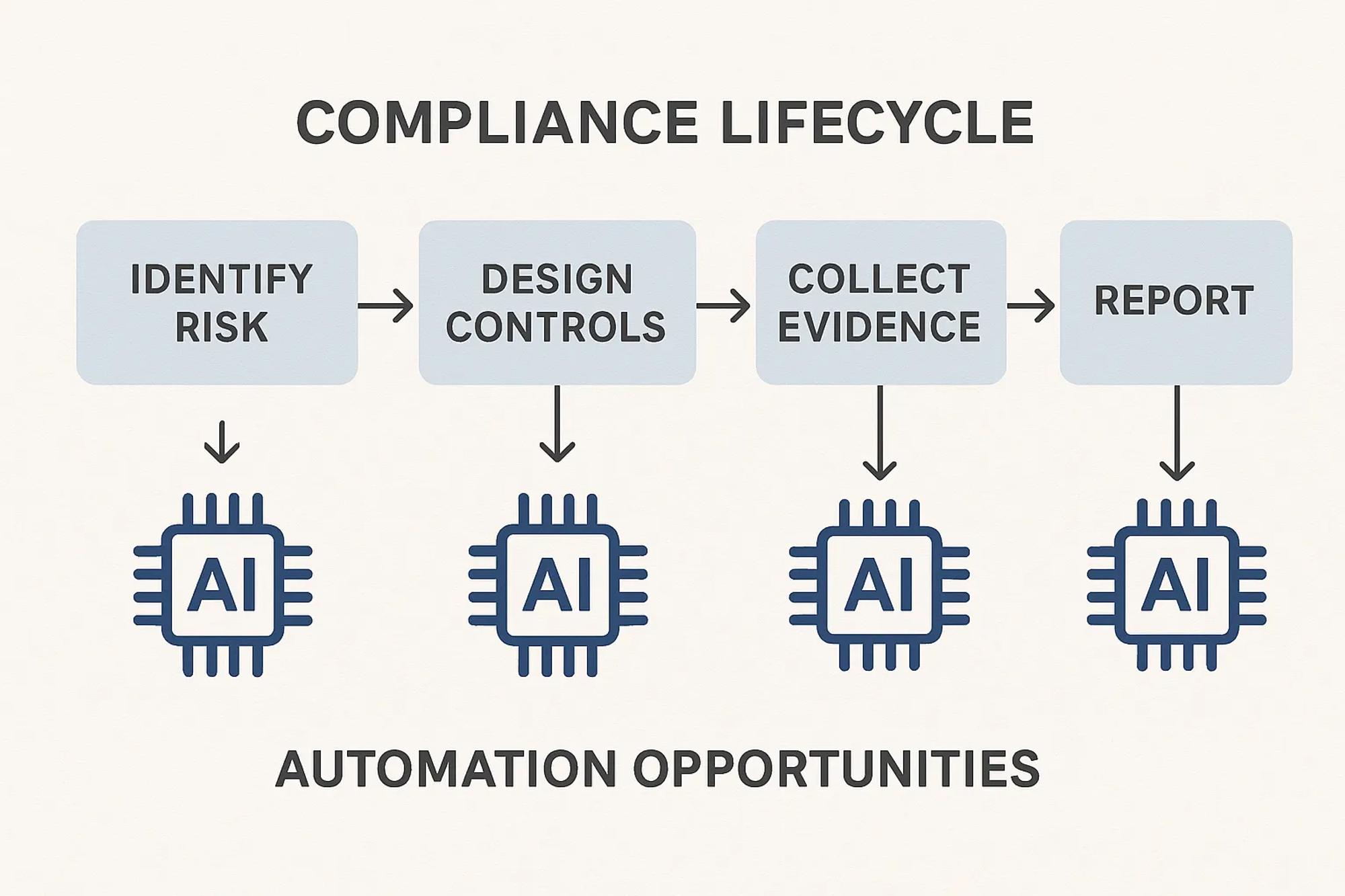
1. Regulatory Risk Assessment | Identify and prioritize obligations by impact and likelihood | Manually compiling laws across jurisdictions | AI-driven regulatory intelligence and dynamic risk scoring |
2. Control & Policy Design | Translate obligations into actionable policies and procedures | Version control of policy documents | Template libraries and collaborative drafting tools |
3. Evidence & Data Collection | Prove that controls operate effectively | Email threads and scattered files | API-based data capture and centralized repositories |
4. Remediation & Issue Tracking | Resolve control failures and audit findings | Lack of ownership and status visibility | Workflow engines with automated reminders |
5. Reporting & Certification | Demonstrate compliance to stakeholders | Time-consuming manual report building | Real-time dashboards and exportable reports |
Below we unpack each step with practical tips and references to recognized frameworks such as ISO 37301 (Compliance Management Systems) and the U.S. DOJ’s “Evaluation of Corporate Compliance Programs.”
1. Regulatory Risk Assessment
Start with a single source of regulatory truth. Maintain a register that maps obligations to business processes, owners, and inherent risk scores. Applying a risk heat map aids prioritization:
- Impact: financial, operational, reputational
- Likelihood: frequency of relevant enforcement actions
- Velocity: speed at which non-compliance would harm the business
Automated platforms like Naltilia flag regulatory changes in real time and recalculate residual risk, letting teams focus on analysis rather than data entry.
2. Control & Policy Design
Convert each high-risk obligation into a specific, testable control. Keep policies short, role-based, and hyperlinked to procedures. Adopt a consistent versioning convention (e.g., ISO year-quarter) and maintain an approval log signed by executive sponsors. Collaborative policy editors minimize version sprawl and retain an audit trail of changes.
3. Evidence & Data Collection
Regulators increasingly ask for operational evidence rather than narrative statements. Examples include:
- Access-control logs to prove least-privilege principles
- Transaction samples showing compliance with sanctions rules
- Training completion records for high-risk roles
Set up automated data pulls—via secure APIs or scheduled file ingests—into a centralized repository. This eliminates last-minute email chases when auditors arrive.
4. Remediation & Issue Tracking
Every audit observation or self-identified control failure should trigger a standardized remediation workflow:
- Root-cause analysis
- Corrective action assignment with target dates
- Validation test
- Lessons-learned review
Workflow automation tools send nudges before due dates and escalate overdue items, ensuring nothing slips through the cracks.
5. Reporting & Certification
Dashboards that visualize risk scores, control effectiveness, and open issues support risk-informed decision making at the board level. Exportable audit packages (evidence files + management assertions) accelerate external assurance. Align report structure with frameworks such as SOC 2, ISO 27001, or your sector-specific standard to avoid re-work.

Tool Categories That Power the Playbook
Choosing technology should follow the workflow, not the other way around. The table below maps core functionality to common solution categories.
Functionality Need | Tool Category | Example Capabilities |
|---|---|---|
Regulatory intelligence & taxonomy | RegTech data feeds | Continuous rule monitoring, jurisdiction filters |
Policy drafting & collaboration | Document lifecycle management | Template libraries, electronic approvals |
Evidence capture & storage | Compliance data lake | API connectors, immutable audit logs |
Workflow enforcement | Compliance process automation | Task routing, SLA tracking, exception alerts |
Analytics & board reporting | GRC analytics dashboards | KPI visualization, export to PDF/XLS |
An integrated platform such as Naltilia combines these categories, reducing vendor sprawl and eliminating costly data hand-offs. The product’s AI layer automatically maps new regulations to existing controls, suggests remediation steps, and populates dashboard metrics—boosting team capacity without additional headcount. Learn more at Naltilia’s feature overview.
Metrics That Prove (and Improve) Compliance Performance
If you cannot measure it, you cannot manage it. The following metrics blend leading indicators (predictive) and lagging indicators (outcome-based) to give a balanced view of program health.
KPI | What It Measures | Calculation | Target Benchmark |
|---|---|---|---|
Control Effectiveness Rate | Percentage of controls operating as designed | (Effective controls ÷ total tested controls) × 100 | ≥ 95 % |
Mean Time to Remediate (MTTR) | Speed of closing compliance issues | Sum of remediation days ÷ number of issues | < 30 days for high-risk items |
Policy Adoption Score | Workforce understanding of key policies | Avg. quiz score × completion rate | ≥ 90 % |
Audit Cycle Time | Days from audit kickoff to final report | Calendar days | −15 % YoY reduction |
Cost per Compliance Activity | Efficiency of program spend | Annual compliance budget ÷ total activities | Declining trend |
Repeat Finding Rate | Recurrence of previously closed issues | Repeat findings ÷ total findings | 0 % aspiration |
Automated evidence collection dramatically improves both MTTR and audit cycle time—metrics executives readily understand.
Operationalizing the Playbook: A 30-60-90-Day Roadmap
- Days 1–30 – Baseline
- Days 31–60 – Automate
- Days 61–90 – Optimize & Report
Governance and Culture Make It Stick
Technology is only Part A; culture is Part B. Sustain momentum by:
- Securing board-level sponsorship and quarterly reviews of KPI trends.
- Embedding compliance checkpoints in product launches and vendor onboarding.
- Rewarding teams for proactive issue identification—not just for clean audits.
Your Next Move
A documented, metrics-driven playbook turns compliance from a cost center into a strategic enabler. Whether you start with a single domain or overhaul the entire program, the combination of repeatable steps, fit-for-purpose tools, and credible KPIs will sharpen your competitive edge and reassure regulators.
Ready to accelerate the journey? Explore how Naltilia’s AI-powered platform automates risk assessment, policy management, data collection, and remediation—so your team can focus on judgment, not paperwork. Visit Naltilia to schedule a personalized walkthrough today.
Frequently Asked Questions
Can a competition authority seize a risk map during a dawn raid?
Yes, if it falls within the scope of the inspection. Seizure is not the issue. A properly built map contains scenarios and controls, not evidence of conduct.
Is a competition risk map an admission of an infringement?
No. A risk map identifies where the company is exposed because of its markets, contacts with competitors and commercial processes. An authority must prove an agreement, an exchange or an abuse. A description of exposure is not that proof.
What is a competition risk map for?
To decide where controls, training and monitoring should go. It is a management tool for allocating compliance effort, not an audit of past conduct and not a litigation file.
What should I do if an interview during the mapping exercise reveals possible misconduct?
Take it out of the mapping exercise and into the internal alert and investigation procedure immediately. The map records the scenario and its controls; the investigation handles the facts, with counsel involved.
Does legal privilege protect a competition risk map?
The map itself is a management document and generally not privileged. The legal opinion on residual risk attached to it can be, depending on the jurisdiction and on who issues it. In France, the 2026 law extends confidentiality to in-house consultations once in force.
Why do companies map corruption risks without the same fear?
Because the law imposes it, article 17 of loi Sapin II in France, and a regulator audits it. The document is no different in nature. The difference is that one is mandatory and the other is recommended.