In compliance, people often use “risk assessment” and “risk management” as if they were interchangeable. They are not, and confusing them creates a very practical problem: teams produce a risk map that looks credible on paper, but they cannot show regulators, auditors, or prosecutors how the organization actually reduced risk over time.
For companies with limited resources (and for legal and compliance teams who need defensible evidence), the distinction matters because many frameworks explicitly expect both: a documented assessment of risks, and an operational system to treat, monitor, and evidence how those risks are controlled.
What risk assessment means in compliance
A risk assessment is the structured process of identifying compliance risks, analyzing how they could occur, and evaluating their significance. In practice, it answers:
- What could go wrong (and where)?
- How likely is it?
- How severe would the impact be (legal, financial, operational, reputational)?
- What is the current exposure before and after controls (inherent vs residual risk)?
Typical outputs of a risk assessment
A compliance risk assessment usually produces elements like:
- A risk universe (the list of relevant risk topics and scenarios, for example bribery, antitrust, AML, criminal compliance, AI governance)
- A risk register with scenarios, scoring logic, and assumptions
- A heat map or prioritization view
- A record of inputs and evidence used (workshops, data sources, past incidents, third-party profiles)
- A documented distinction between inherent risk (before controls) and residual risk (after controls)
A helpful way to think about it is this: risk assessment is your diagnosis.
Where risk assessment shows up in key frameworks
Risk assessment is not optional in most modern compliance frameworks. For example:
- Loi Sapin II (France) includes a formal risk mapping requirement as one of the core pillars of an anti-corruption program.
- ISO 37001 (anti-bribery) expects organizations to perform bribery risk assessments to design proportionate controls. S
- UNE 19601 (criminal compliance in Spain) and UNE 19603 (antitrust compliance in Spain) both rely on risk analysis as the foundation for an effective prevention model.
- AML regimes are built on the “risk-based approach” promoted by the FATF.
- Under the EU AI Act, many obligations are explicitly tied to risk levels, and high-risk AI providers must implement a risk management system.
A mature program starts with a solid assessment, but it cannot end there.
What risk management means in compliance
Risk management is the broader, ongoing system used to make decisions and take action based on the assessment.
It includes risk assessment, but expands into governance, control design, remediation, monitoring, reporting, and continuous improvement. It answers:
- What are we going to do about the risks we identified?
- Which controls reduce them, who owns those controls, and how do we prove they work?
- What is the plan when controls fail or incidents occur?
- How do we keep the assessment current as the business and regulations change?
Risk management is your treatment plan plus follow-up.
Typical outputs of risk management
A risk management system usually includes:
- Risk appetite or tolerance statements (even if lightweight)
- A control framework linked to risks (policies, procedures, training, due diligence, approvals, monitoring controls)
- A remediation plan with owners, deadlines, and escalation rules
- Evidence of control performance (not just control existence)
- A cadence for testing and monitoring
- Board and management reporting (KPIs, KRIs, trends, exceptions)
- A process to update risks after changes (new markets, new third parties, new products, new AI systems)
If risk assessment tells you “these are our top 12 scenarios,” risk management is what ensures those scenarios are actually being mitigated, and that you can prove it.
The simplest way to remember the difference
Risk assessment is a step. Risk management is a system.
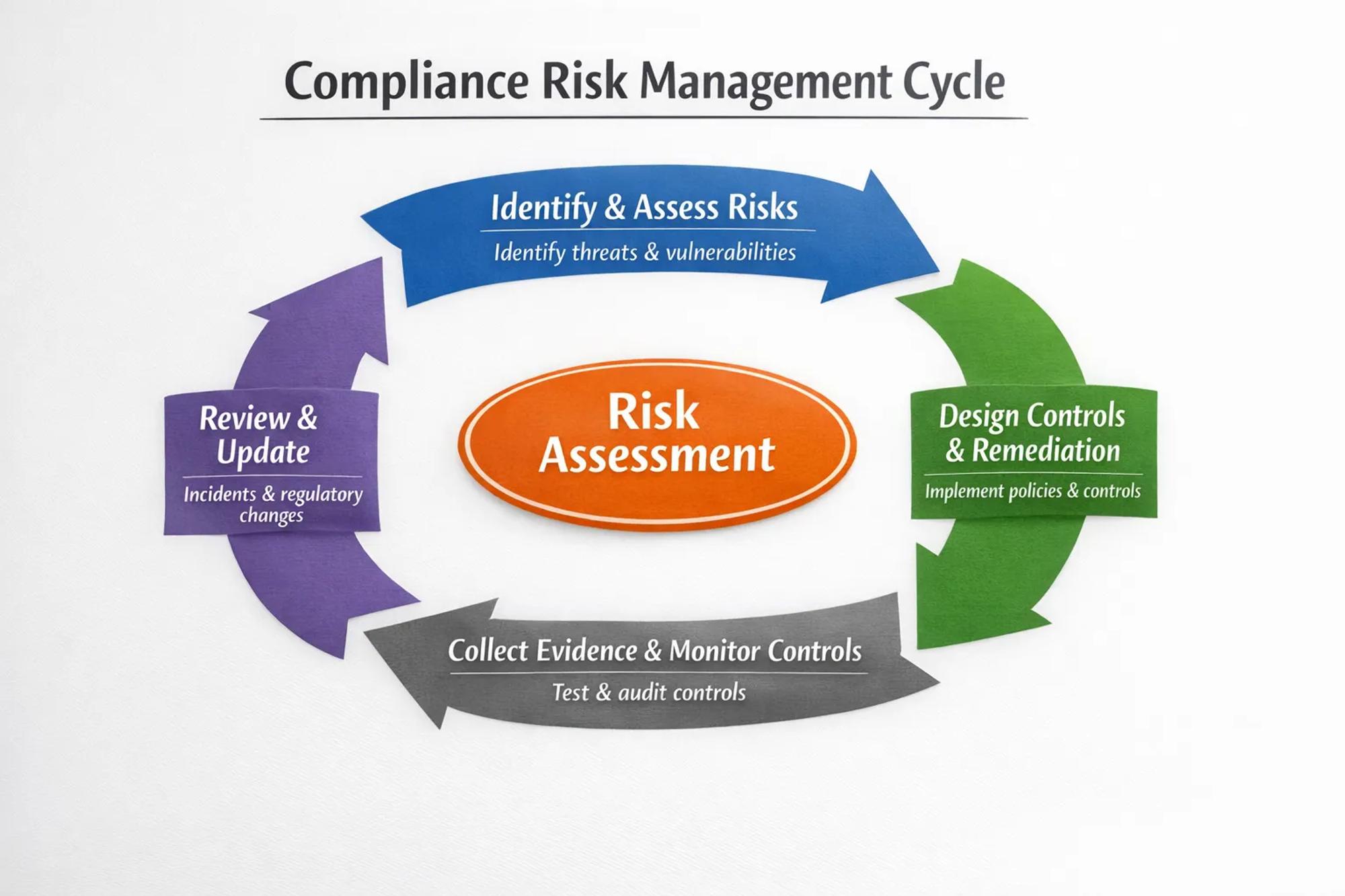
Comparison table: risk assessment vs risk management
Topic | Risk assessment | Risk management |
|---|---|---|
Main purpose | Prioritize compliance risks | Reduce and control compliance risks over time |
Time horizon | Point-in-time snapshot (even if repeated) | Continuous cycle |
Core questions | “What are our risks and how big are they?” | “What are we doing about them, and is it working?” |
Typical owner | Compliance (with business input) | Shared ownership across compliance, legal, business, internal control |
Typical evidence | Risk register, scoring rationale, workshop notes | Control performance evidence, remediation tracking, monitoring logs, board reporting |
Common failure mode | Beautiful heat map with no operational follow-through | Lots of controls with no clear link to risk priorities |
How the difference plays out in real compliance areas
The same distinction applies across anti-corruption, antitrust, AML, criminal compliance, and AI governance. What changes is the risk language and the evidence regulators expect.
Example 1: anti-corruption (Loi Sapin II, ISO 37001)
Risk assessment might look like:
- Identify bribery scenarios (use of intermediaries, gifts and hospitality, public tenders, facilitation payments)
- Score inherent risk using country exposure, public official touchpoints, sales incentives, third-party reliance
- Evaluate residual risk based on existing controls (due diligence, approvals, accounting controls, training)
Risk management is what follows:
- Implement or update third-party due diligence requirements and approval workflows
- Roll out targeted training for high-risk roles
- Ensure accounting controls are actually preventing and detecting irregular payments
- Track remediation actions when gaps are found (for example missing contracts, incomplete screening, overdue attestations)
- Monitor KPIs such as due diligence coverage, time-to-remediate, and control exceptions
If you want a deeper view on how risk determination is treated in the anti-bribery context, Naltilia’s field-oriented perspective in risk determination in ISO 37001 is a useful complement.
Example 2: antitrust compliance (UNE 19603, CNMC expectations)
Risk assessment might look like:
- Identify where competition law risks arise (sales negotiations, distributor management, industry association meetings, information exchanges)
- Map scenarios like resale price maintenance, bid rigging red flags, and sensitive data sharing
- Prioritize by exposure (market structure, role types, frequency of competitor contact)
Risk management focuses on execution:
- Introduce meeting rules and pre-clearance for industry association participation
- Update commercial templates and playbooks (what can be discussed, what must be escalated)
- Train the roles that create antitrust risk (not the whole company equally)
- Monitor key signals such as association attendance, approvals, and hotline trends
For teams following developments in Spain, the ongoing discussion around effectiveness criteria is well captured in Naltilia’s summary of the update of CNMC’s antitrust compliance guidelines.
Example 3: AML (risk-based approach)
Risk assessment typically includes:
- Customer risk categories, product risk, geography risk, and channel risk
- Scoring logic and rationale aligned to your business model
Risk management includes:
- Ongoing due diligence controls (CDD triggers)
- Monitoring and alert handling procedures
- Clear ownership, escalation, and evidence trails
This is where many organizations struggle: the assessment exists, but the operating model for ongoing monitoring is not resourced or measurable.
Example 4: AI governance (EU AI Act)
Under the EU AI Act, “risk” is not just a general concept, it is built into the legal structure.
Risk assessment might include:
- Inventory AI systems and classify them (prohibited, high-risk, transparency obligations, minimal risk)
- Identify risks to fundamental rights, safety, and compliance obligations depending on your role (provider vs deployer)
Risk management means:
- Putting in place controls such as documentation, human oversight, incident handling, and vendor governance
- Maintaining evidence that the process is applied consistently as models, data, and use cases evolve
Naltilia’s AI Act readiness: compliance management that scales is a practical bridge between classification work (assessment) and what “ongoing compliance” looks like (management).
A practical checklist: are you assessing, or managing?
If you are unsure where your program currently sits, use these reality checks.
Signs you are mostly doing risk assessment
You likely have:
- A risk map or risk register that is updated annually (or less)
- Workshop-based scoring, but limited data-driven refresh
- Weak linkage between top risks and budget, controls, or monitoring
- Limited evidence showing whether controls actually operate as designed
Signs you are doing risk management
You likely have:
- Clear control owners and a remediation workflow
- Defined monitoring cadence, including control testing
- Board-level reporting that includes trends and exceptions (not only activity counts)
- A process to update risks when business conditions change
A frequent gap is what some auditors call “paper compliance”: documentation exists, but there is not enough operational proof that the program is effective. Naltilia addresses that exact dynamic in why paper compliance does not work.
How to connect assessment to management (without building a bureaucracy)
Companies often need a lightweight model that still holds up under scrutiny. The key is to design your assessment outputs so they can directly drive risk treatment and monitoring.
Step 1: write risks as scenarios, not topics
“Bribery” is a topic. A defensible risk statement is a scenario, for example:
- “Sales agents use intermediaries to influence public procurement decisions in Country X.”
- “Commercial teams exchange sensitive information with competitors during association meetings.”
Scenarios make it much easier to assign controls, owners, and evidence.
Step 2: require a “control link” for every top risk
For each high and medium-high scenario, be explicit about:
- Which controls prevent it
- Which controls detect it
- Who owns each control
- What evidence proves the control operated
This is where risk assessment becomes risk management.
Step 3: track remediation like you track business delivery
If the assessment reveals gaps, treat them as managed work:
- Assign an owner, deadline, and acceptance criteria
- Define escalation rules
- Keep an audit trail of what changed and why
Step 4: monitor a small set of meaningful metrics
Try to avoid metrics that only show activity (for example “number of trainings delivered”). Add effectiveness signals, such as:
- Overdue remediation items by risk level
- Control completion rates for high-risk controls
- Exceptions found during monitoring and how quickly they are closed
- Residual risk trend for the top risk scenarios
If you need examples that resonate with senior leadership, Naltilia’s compliance dashboard risk metrics your board actually cares about is a solid reference.
What to document to make the difference defensible
When regulators or auditors challenge a program, they usually test traceability: can you connect risks to decisions, decisions to controls, and controls to evidence?
This table summarizes what typically needs to exist to show a clean chain.
Program element | What “good” looks like | Why it matters |
|---|---|---|
Risk assessment method | Clear scoring logic, defined scope, documented assumptions | Shows consistency and avoids arbitrary ratings |
Risk-to-control mapping | Each priority risk has named controls and owners | Proves the program is risk-based, not generic |
Remediation tracking | Actions have owners, deadlines, evidence of completion | Demonstrates the program improves, not just describes |
Control monitoring | Scheduled checks, exceptions, follow-up | Demonstrates operational effectiveness |
Change management | Triggers to update risks (new market, M&A, new AI system) | Prevents the risk map from becoming outdated |
Where technology helps (and where it should not replace judgment)
Risk assessment and management are both documentation-heavy, which is why they often become spreadsheet-driven and fragile. Technology is most valuable when it reduces friction in the parts humans are worst at doing consistently.
In practice, that means helping teams:
- Collect data and evidence without endless chasing
- Maintain workflows for approvals and remediation
- Keep risk registers and control libraries consistent
- Produce reporting that is timely and traceable
Naltilia’s platform is designed to support that operating layer through regulatory risk assessment, remediation actions, tailor-made policies, automated data collection, and compliance workflow automation. If you want a process-focused overview tailored to smaller teams, see compliance risk management: a practical guide for SMEs. And if your immediate priority is specifically risk mapping, start with compliance risk mapping: the complete guide for companies.
Conclusion
If you only do risk assessment, you know where you are exposed.
If you do risk management, you can prove you are reducing that exposure, that controls operate in practice, and that your program adapts as regulations and business models change. For compliance officers and lawyers in organizations, that proof is often the difference between “we have a policy” and “we have an effective compliance program.”