
Earlier this month, Sequoia Capital partner Julien Bek published a thesis that sent ripples through the venture world. The title was spare: services: the new software. The argument was sharper still — the next trillion-dollar company will not sell tools. It will leverage AI to sell the work itself. For most industries, that is an interesting observation. For the compliance sector, it is a direct description of what is about to happen.
The intelligence - judgment divide
The most important contribution of Bek’s framework is a clean distinction between two categories of knowledge work: intelligence and judgment.
Intelligence work follows rules, even complex ones. It requires gathering information, reviewing documents, mapping requirements, comparing states, and producing structured outputs.
It is cognitively demanding but ultimately deterministic: given the same inputs, a competent professional would reach the same conclusion. The work is necessary. It is rigorous. But it is, fundamentally, rule-following at scale.
Judgment work is different in kind, not just degree. It requires interpreting ambiguity, weighing competing interests, understanding context that is not written anywhere, and making decisions whose consequences ripple across an organisation. It cannot be reduced to a checklist.
It is built on years of pattern recognition that cannot yet be encoded into a prompt — the intuition of a seasoned regulator, the instinct of an experienced partner, the feel for what a supervisor will actually care about.
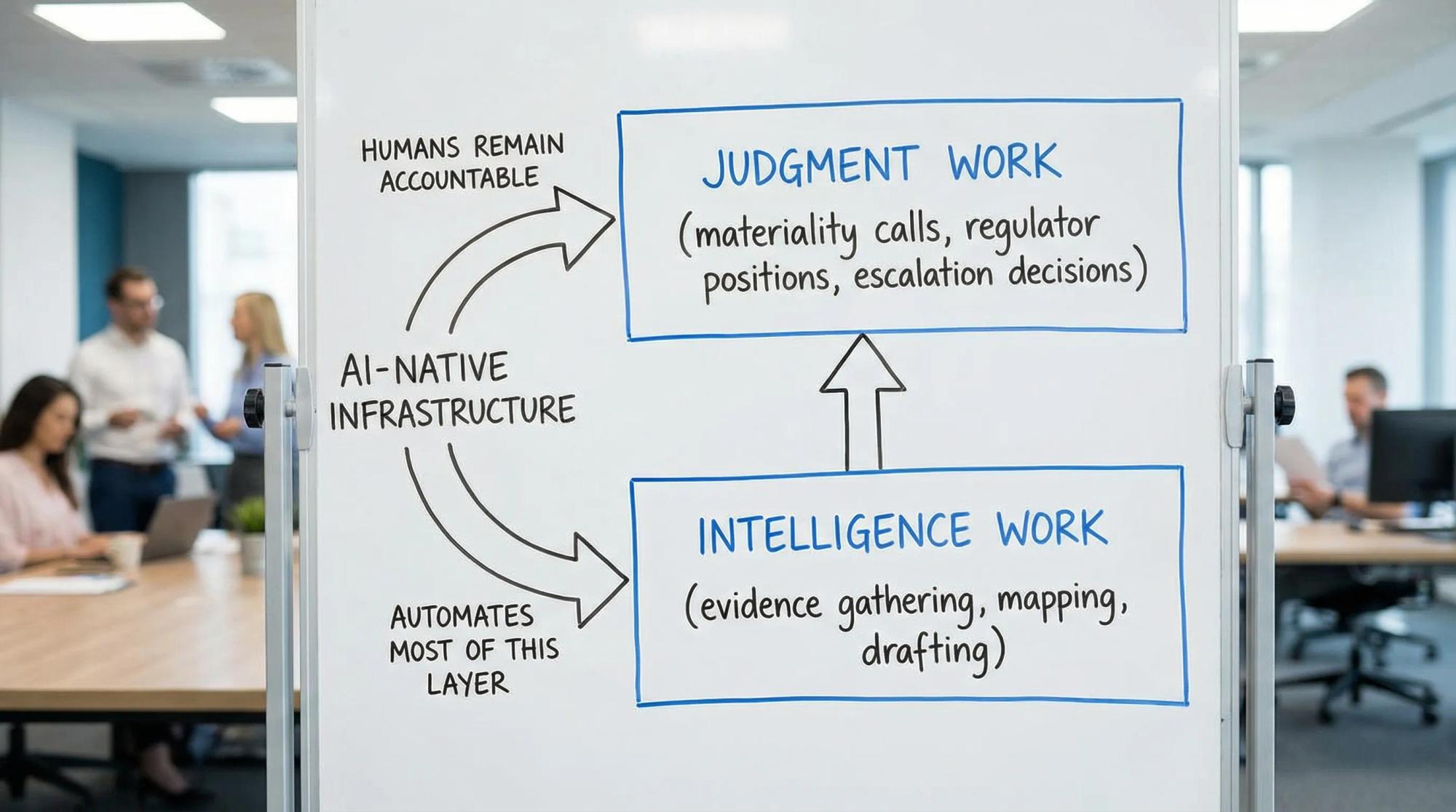
This distinction matters enormously in compliance, because the field contains both — in very different proportions. And that imbalance is where the entire opportunity lives.
Task | Layer | Automatable today? |
|---|---|---|
Evidence gathering & documentation | Intelligence | Largely yes |
Policy & control mapping | Intelligence | Largely yes |
Vendor / third-party questionnaires | Intelligence | Largely yes |
Risk register population | Intelligence | Largely yes |
Gap analysis against new frameworks | Intelligence | Largely yes |
Draft reporting for regulators | Intelligence | Increasingly yes |
Materiality determinations | Judgment | No |
Legal interpretation of novel provisions | Judgment | Not yet |
Regulator-facing positions | Judgment | No |
Escalation decisions | Judgment | No |
The bureaucracy problem
Here is the quiet crisis inside every compliance team and every advisory firm: the best people spend most of their time on the work that least requires them.
A senior compliance officer with fifteen years of experience — someone whose judgment on a sanctions escalation is genuinely irreplaceable, whose read on a regulator's priorities is worth more than any framework document — spends the bulk of their week populating spreadsheets, chasing document requests, and coordinating evidence packs. The expertise is present. The bureaucracy is consuming it.
The same dynamic plays out inside advisory firms, often invisibly. Partners supervise the production of intelligence-layer deliverables. Associates build risk registers and draft gap analyses. Senior consultants review evidence packs.
This is not a technology problem. It is a structural one. The talent is there. The expertise is there. The problem is the architecture of how compliance work gets done — an architecture that routes the most expensive resource through the most procedural tasks before it can reach the problems that actually justify the cost.
AI changes that architecture entirely. Not by replacing the expert. By clearing the path to the expert.
The autopilot model in compliance
What does it actually look like to sell the work rather than the tool? Not a platform. Not an assistant. Not a feature added to an existing workflow. The work — done, delivered, ready to use.
It looks like this:
→ "Here is your risk assessment — completed." Controls mapped, gaps identified, remediation priorities ranked. Ready to present to the board.
→ "Here is your third-party review — completed." Vendors assessed, questionnaires consolidated, red flags surfaced and annotated. Ready to sign off.
→ "Here is your controls framework — completed." Mapped to the applicable regulation, cross-referenced against your existing policies, tested against current state. Ready for audit.
→ "Here is your evidence pack — completed." Documents gathered, organised, and annotated for the upcoming examination. Ready to hand over.
→ "Here is your gap analysis — completed." New regulatory requirements assessed against your current state, with a prioritised remediation roadmap attached.
The client receives a deliverable — the work, done.
This is what Sequoia means by the autopilot model. A service that delivers outcomes at a cost and speed that were previously impossible. The client experience is unchanged — they still receive completed work from a trusted provider. What changes is everything underneath: how fast it arrives, how much it costs to produce, and how much expert attention is left over for the questions that genuinely require it.
The opportunity hiding in plain sight
Compliance consulting is a services market. The spend was always there. Services spend already exists, in defined budget lines, with buyers who understand precisely what they are purchasing and have been purchasing it for years.
Bek's thesis articulates the entry logic precisely: the correct wedge for AI-native service companies is where outsourcing already exists. If a task is already sent to an external provider, three things are already true. The client has accepted that the work can be performed outside the organisation. There is a cleanly defined budget line that can be replaced. And the buyer is already purchasing outcomes, not headcount.
Replacing an outsourced compliance engagement with an AI-native service provider is a vendor switch. It requires a commercial conversation, not an organisational transformation. There is no change management programme, no internal champion to recruit, no technology budget to unlock. The line item already exists. The question is only who fills it.
The compliance advisory market is, in this sense, ideal terrain. Large, established, outsourcing-native, and almost entirely built on intelligence-layer labour. Every management consulting firm, every Big Four advisory practice, every specialist compliance boutique is, right now, deploying significant human capital on work that AI can handle — and billing accordingly. The opportunity for those firms to do far more, at higher margin, has never been greater.
What this means for compliance advisory firms
For established compliance consulting firms, law firms with regulatory practices, and Big Four advisory teams, the Sequoia thesis is an infrastructure announcement. The infrastructure to automate the intelligence layer now exists. The question is not whether it will be used — it will be — but who uses it first, and at what scale.
The firms that move first will compress time-to-deliverable on intelligence-layer work by an order of magnitude. A risk assessment that takes three weeks with a traditional engagement model can be produced in days. An evidence pack that requires two junior staff members working full-time can be generated overnight. A gap analysis across a new regulatory framework can be completed before the client has finished reading the final text of the regulation.
That compression amplifies the value of every engagement. The expert judgment — the materiality call, the regulator-facing interpretation, the strategic escalation decision, the question of what this means for the client's specific business — is still required. It is more required, because it is no longer buried under the weeks of preparation that preceded it. The senior advisor arrives at the judgment faster, with better inputs, and with more time to apply the expertise that clients are actually paying for.
The service model is also structurally resilient. Every improvement in the underlying AI models makes the service faster, cheaper, and more precise. A firm that has built its delivery model on AI-native infrastructure gets a better engine with every model generation. Its cost of delivery falls. Its margin improves. Its speed to client increases. The better the AI gets, the stronger the position.
The competitive window
There is a window here, and it is opening wide for the firms that act. The compliance advisory market is entering a period of significant expansion — driven by regulatory complexity, cross-border requirements, and the rising cost of non-compliance for clients across every sector. The demand for high-quality compliance advisory work has never been higher. What AI-native infrastructure does is allow firms to meet that demand at a scale that was previously impossible.
The advantage available to established advisory firms is real and durable: trust, relationships, regulatory credibility, and domain expertise built over years of practice. These advantages compound when deployed into the new model. A firm that combines deep regulatory expertise with AI-native delivery infrastructure can serve more clients, at higher quality, with faster turnaround, than any traditional model allows.
The judgment layer of compliance work — the part that clients value most — is not going anywhere. AI cannot yet interpret a genuinely novel regulatory provision, negotiate a consent order, or advise on the reputational dimensions of a disclosure decision. What it can do is everything that precedes those moments: the gathering, the mapping, the testing, the drafting, the organising. It clears the ground so that expert judgment lands exactly where it is needed, at full force, without weeks of preparation standing between the expert and the problem.
The firms that understand this will put genuine expertise back where it belongs: on the hardest problems, with the clients who most need it solved. And they will do it at a scale that was simply not available before.
The scale effect: more missions, more value, more impact
The most tangible expression of this opportunity is capacity. The ceiling is not ambition or expertise — it is throughput. The intelligence-layer work that precedes every judgment call consumes the calendar before the genuinely valuable work has even begun. The pipeline fills up. New mandates get deferred. Clients wait.
When AI handles that layer, the constraint lifts entirely.
The same expert who previously managed three missions can now manage 3-4 times more missions. Not by working longer hours or cutting corners, but by arriving at the judgment-layer work immediately — without weeks of preparation standing in the way. The evidence pack is ready. The gap analysis is done. The risk register is populated. The expert walks in and does what only the expert can do.
For lawyers and compliance consultants, this is a structural expansion of practice capacity that translates directly into revenue, reputation, and reach. More mandates means more client relationships, a wider base of institutional knowledge, and a practice that grows with every engagement rather than plateauing at the limit of what a team can manually process. A boutique firm that currently runs fifteen engagements per year can run forty. A Big Four team that deploys six people on a single risk assessment can redeploy five of them to new clients. The economics do not compress — they scale.
Beyond throughput, there is a compounding effect that matters just as much. When experts spend the majority of their time on judgment-layer work — on the problems that genuinely require them — their expertise deepens faster. They encounter more edge cases, develop sharper instincts, and build a body of advisory work that is genuinely differentiated. The practice becomes known for the quality of its thinking, not the efficiency of its paperwork. That reputation attracts more complex mandates, which deepen expertise further. The cycle compounds.
The best compliance professionals and lawyers already sense this. The frustration is not the work itself — it is the ratio. The ratio of time spent on procedural tasks versus time spent on the problems worth solving. AI-native service delivery changes that ratio permanently and decisively. And when the ratio changes, so does everything else: the quality of advice, the depth of client relationships, the reputation of the practice, and the value it commands in the market.
This is the opportunity for advisory firms that move now. Not to do the same work with fewer people. To do far more work, at higher quality, with the same people — and to build a practice that compounds rather than plateaus.
The next big compliance winner
Sequoia's thesis ends with a prediction: the next trillion-dollar company will be a software company masquerading as a services firm. In compliance, the winner will look, to clients, exactly like a compliance services firm. It will produce the same deliverables, maintain the same client relationships, carry the same professional credibility, and speak the same language.
The difference will be invisible from the outside. Inside, the intelligence layer will run on AI. The judgment layer will run on the expertise of people who are, finally, doing only the work that requires them. The bureaucracy will be gone. What remains is the part that was always worth paying for.
The infrastructure exists. The market is ready. The question — as it always is — is who moves first.