
Enron did not fail because it lacked documents. It failed because a code of ethics in business was treated as branding, while leadership signals, incentives, and governance quietly taught people what “success” really meant.
What makes Enron a useful case for compliance officers in 2026 is not the accounting detail. It is the operational pattern: a culture that rewarded boundary-pushing, sidelined challenge, and treated internal warnings as a problem to manage, not a risk to fix.
What happened at Enron (in plain language)
Enron grew fast in the 1990s by evolving from a traditional energy company into a complex trading business. Over time, it relied on aggressive accounting and off-balance-sheet structures to present stronger financial results than the underlying economics supported. When confidence collapsed, so did access to financing.
In late 2001, Enron filed for bankruptcy, which at the time was the largest in US history. The scandal also contributed to the demise of Arthur Andersen and helped accelerate major governance and reporting reforms, including the US Sarbanes-Oxley Act (SOX) of 2002.
The 7 Enron ethics traps everybody ignored (and how to spot them early)
Each trap below includes: what it looked like at Enron, the modern control you can implement, and what “evidence of effectiveness” looks like (because that is what auditors and regulators increasingly test).
1) “Values” that do not survive a hard business decision
What it looked like at Enron. Enron had a formal code of ethics, but its application was not consistent with senior decision-making. One widely cited example is the waiver of the code in relation to conflicts connected to CFO Andrew Fastow’s partnerships.
Fastow was not just a finance executive signing off on Enron’s numbers. He also helped set up and manage outside partnerships (special purpose entities) that did business with Enron, including transactions designed to move debt or losses away from Enron’s balance sheet.
That arrangement created several overlapping conflicts:
- Self-dealing risk: If the CFO personally benefited from the outside partnerships (through fees, equity, or performance payouts), he could be incentivized to structure deals that were good for the partnership and for his compensation, not necessarily good for Enron or its shareholders.
- Approval and oversight breakdown: A CFO is typically a gatekeeper for accounting treatment, disclosure, and risk. If the same person is also tied to the counterparty, internal review becomes compromised because the “checker” is effectively involved in the “doer.”
The practical point for modern compliance is that the ethical issue is not only “conflict of interest exists.” It is that leadership normalized the idea that conflicts could be managed by exception when the deal was important enough, which teaches the organization that rules are flexible for high performers.
Why compliance teams should care. Employees learn what the company really means by ethics when a senior performer, a key deal, or a financial target collides with the rules.
Practical control. Create a “non-waiver” rule set and escalation protocol:
- Define which standards are non-waivable (for example, conflicts of interest disclosures, accounting integrity, retaliation prohibitions).
- If an exception is legally possible, require independent review and documented rationale.
Evidence that works in audits. A controlled exception register with: requester, approver, rationale, compensating controls, expiry date, and post-exception review.
2) Tone at the top that rewards outcomes, not integrity
What it looked like at Enron. The scandal is consistently described as a leadership and governance failure as much as a reporting failure. When leadership behavior signals that targets and deal volume matter more than transparency, people adapt.
Why it matters. Under modern expectations, leadership commitment is not a speech. It is resource allocation, decision records, and consequences.
Practical control. Add “tone evidence” to your governance cadence:
- Quarterly leadership review of the top ethics risks and top three cultural friction points.
- A standing agenda item: “where did we accept risk this quarter, and why?”
Evidence that works in audits. Minutes that show challenge, decisions, owners, deadlines, and follow-through (not just attendance).
3) Complexity used as camouflage
What it looked like at Enron. The business model, financial structures, and reporting became too complex for many stakeholders to understand and challenge. Complexity is not inherently wrong, but it becomes dangerous when it reduces scrutiny.
Modern red flag. Any area where “only two people understand it” is a control failure waiting to happen.
Practical control. Treat “explainability” as a control objective:
- Require plain-language narratives for high-risk structures (financial, commercial, or operational).
- Define minimum documentation for high-impact transactions: purpose, counterparties, approvals, accounting treatment, and key assumptions.
Evidence that works in audits. A sample-based review showing that narratives exist, approvals match authority levels, and assumptions were independently checked.
4) A second line that cannot challenge, or is not listened to
What it looked like at Enron. Where the business holds all the informational power, compliance, legal, risk, and internal audit can be reduced to advisory roles with limited ability to stop decisions.
Why it matters. Standards like ISO 37001 (anti-bribery management systems) emphasize independence, authority, and adequate resources for the compliance function. Even outside bribery, the principle generalizes: an ethics program is weak if challenge is optional.
Practical control. Formalize “stopping power” for defined scenarios:
- For specified red flags, require a documented sign-off from a control function before execution.
- If overruled, require an executive-level override with rationale.
Evidence that works in audits. Override logs and a trend analysis showing whether overrides are rare, justified, and corrected over time.
5) Speak-up culture was inexistant
What it looked like at Enron. People had reasons to stay silent: fear of career impact, fear of being labeled “not commercial,” and pressure to conform.
Modern lesson. Speak-up is not only a hotline. It is whether employees believe that raising a concern results in fair triage, protection, and visible remediation.
Practical control. Build “speak-up trust” into your control testing:
- Test how long it takes to acknowledge a report.
- Test whether reporters receive closure (where appropriate).
- Track retaliation allegations as a separate, board-visible metric.
Evidence that works in audits. Case-management records (appropriately protected), timeliness SLAs, and remediation tracking tied back to root causes.
6) Whistleblowing handled as a reputational problem, not a risk signal
What it looked like at Enron. Sherron Watkins, an Enron executive, raised concerns internally in 2001 about accounting and the risk of “implosion.” Her story is a reminder that internal reporting can happen well before the public crisis, and that what the company does next determines whether reporting is useful or futile.
Practical control. Use a triage decision tree that forces action, not debate.
Triage decision tree (use in your procedure):
- Is the allegation about financial reporting, senior leadership, or obstruction?
- Is there a credible retaliation risk?
- Is there an operational root cause?
Evidence that works in audits. A documented chain of custody for decisions: intake, triage rationale, investigation plan, findings, remediation, and feedback.
How to turn Enron’s lessons into an audit-ready ethics program
Most ethics failures are not a lack of documents, they are a lack of commitment and oversight, and then a lack of operational proof.
Enron’s case is the uncomfortable reminder that policies can exist while leadership incentives point in the opposite direction. The top of the house did not consistently commit to ethics when ethics conflicted with the business story. That absence of real commitment translated into a culture where business outcomes were prioritized beyond integrity, and where the second line and internal warnings were easier to minimize than to act on.
An audit-ready ethics program would not have “saved Enron” on its own. But it could have made the signals harder to ignore earlier by forcing traceability: who approved exceptions, who overrode controls, what the audit committee reviewed, what actions were taken, and what never got closed. At Enron, too few people were effectively controlling, and too many people did not want to look closely because the growth narrative was too compelling.
The practical takeaway is simple and strict: you do not get an ethical culture without commitment from the top, and you do not keep it without a Board (and especially an audit committee) that actually interrogates audit reports, challenges management, and follows through until remediation is verified.
A lightweight “ethics effectiveness pack” checklist
Use this checklist to prepare for internal audit, external reviewers, or regulator-style questions.
- Governance: committee charter, meeting minutes, decisions, and follow-up actions.
- Code of conduct: version control, targeted communication, attestations, and exception handling.
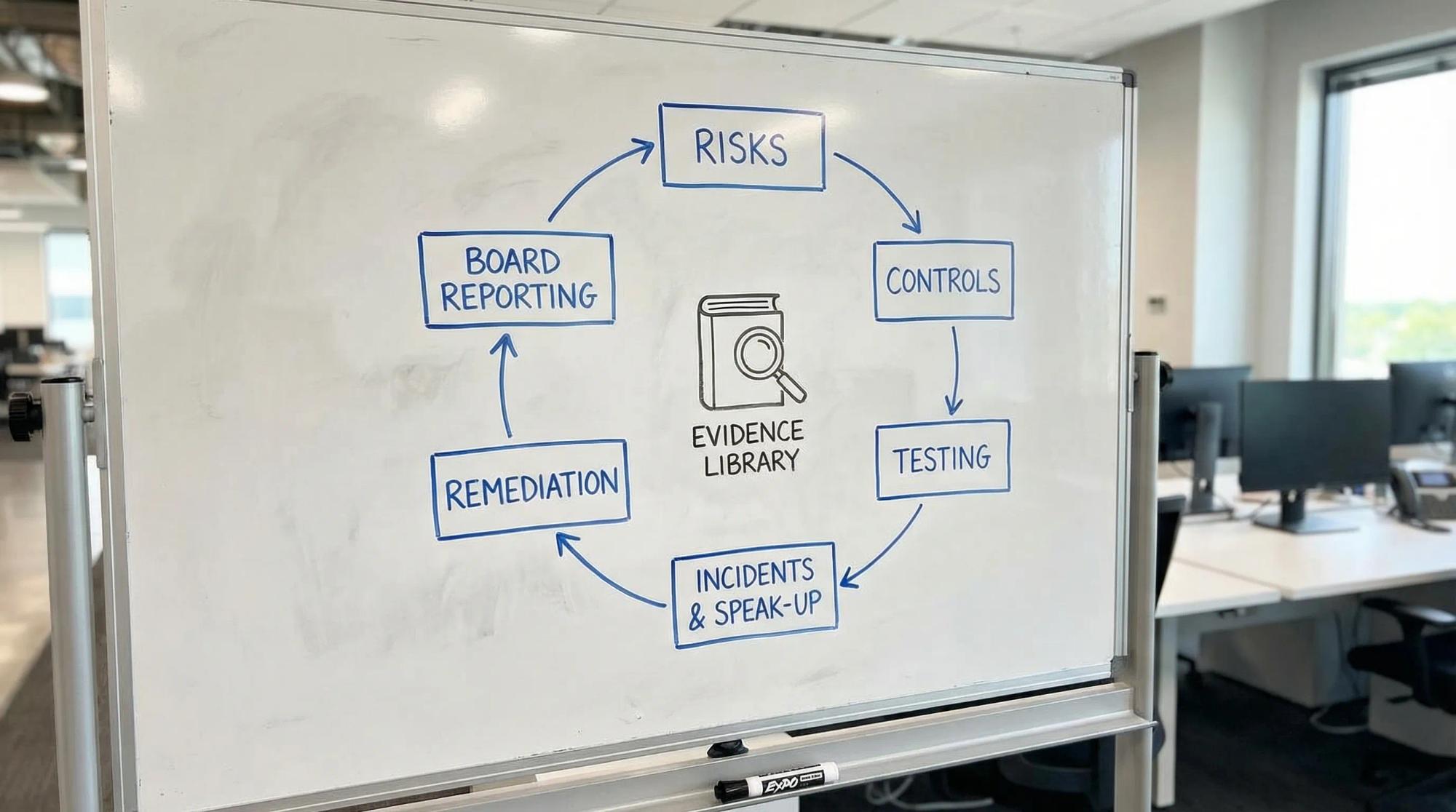
- Risk mapping: most material ethics risks, owners, refresh cadence, and how changes are captured.
- Speak-up: intake channels, triage rules, investigation governance, retaliation protections, and closure.
- Controls: design documentation plus evidence of operating effectiveness (testing results, not just control descriptions).
- Remediation: action tracking with deadlines, ownership, and verification of completion.
- Metrics: a board-facing dashboard with trends, thresholds, and actions taken.
How Naltilia can help
When you try to operationalize these lessons, the friction is usually the same: collecting evidence, chasing owners, and keeping risk mapping and remediation current across teams and countries. Naltilia supports compliance teams by structuring regulatory risk assessments, translating them into remediation actions with owners and deadlines, automating data collection requests for audit-ready evidence, and maintaining tailored policies that stay aligned with how the business actually works.
Frequently asked questions
Did Enron have a code of ethics? Yes. Enron had a formal code, but the scandal illustrates that a code of ethics in business is only as strong as leadership behavior, incentives, and enforcement.
What is the main compliance lesson from Enron? Build proof of effectiveness. Ensure governance can challenge revenue decisions, exceptions are controlled, speak-up is trusted, and remediation is tracked to closure.
How do you test whether “tone at the top” is real? Look for decision evidence: resourcing decisions, documented trade-offs, disciplinary consistency (including for high performers), and whether leaders accept bad news without retaliation.
What should a whistleblowing process do differently than Enron did? Treat reports as risk signals. Use clear triage rules, independent oversight for senior or financial-reporting allegations, strong anti-retaliation protections, and documented remediation.
What would auditors expect to see beyond policies? Traceability: risk mapping that links to controls, evidence that controls operate, logs of exceptions and overrides, investigation records, and remediation proof with owners and deadlines.
Contact Naltilia here.
This article is general information, not legal advice.