
IIt's 10:47 pm, and you're still polishing the compliance pack for tomorrow's board meeting.
Sixty pages. Heat maps. A policy update section you know nobody will read.
And you can already hear the only question you'll get: "so are we fine?"
That moment is not a communication problem. It's a reporting model problem.
If your board only ever sees compliance as a quarterly document, they will treat it like one: skim, park, move on.
Why boards tune out compliance reports (the real reasons)
Boards tune out because most compliance reporting is built to prove effort, not to drive decisions.
A long report is usually a symptom of fear — fear of missing something, fear of being blamed later, fear of simplifying legal nuance.
But a board does not govern nuance. A board governs exposure, risk appetite, and resource allocation.
So when we show them:
- activity (trainings delivered, due diligence performed)
- legal commentary (summaries of regulatory updates)
- disconnected facts (incidents listed without business impact)
…we are speaking a language they are not paid to speak.
Regulators are pushing in the same direction. The U.S. Department of Justice's guidance on program evaluation is explicit: they look for programs that work in practice, and they ask about access to data, timely remediation, and whether the program is "adequately resourced and empowered" (read it directly in the DOJ Evaluation of Corporate Compliance Programs).
A 60-page report rarely answers any of that.
What boards actually want to see on one page
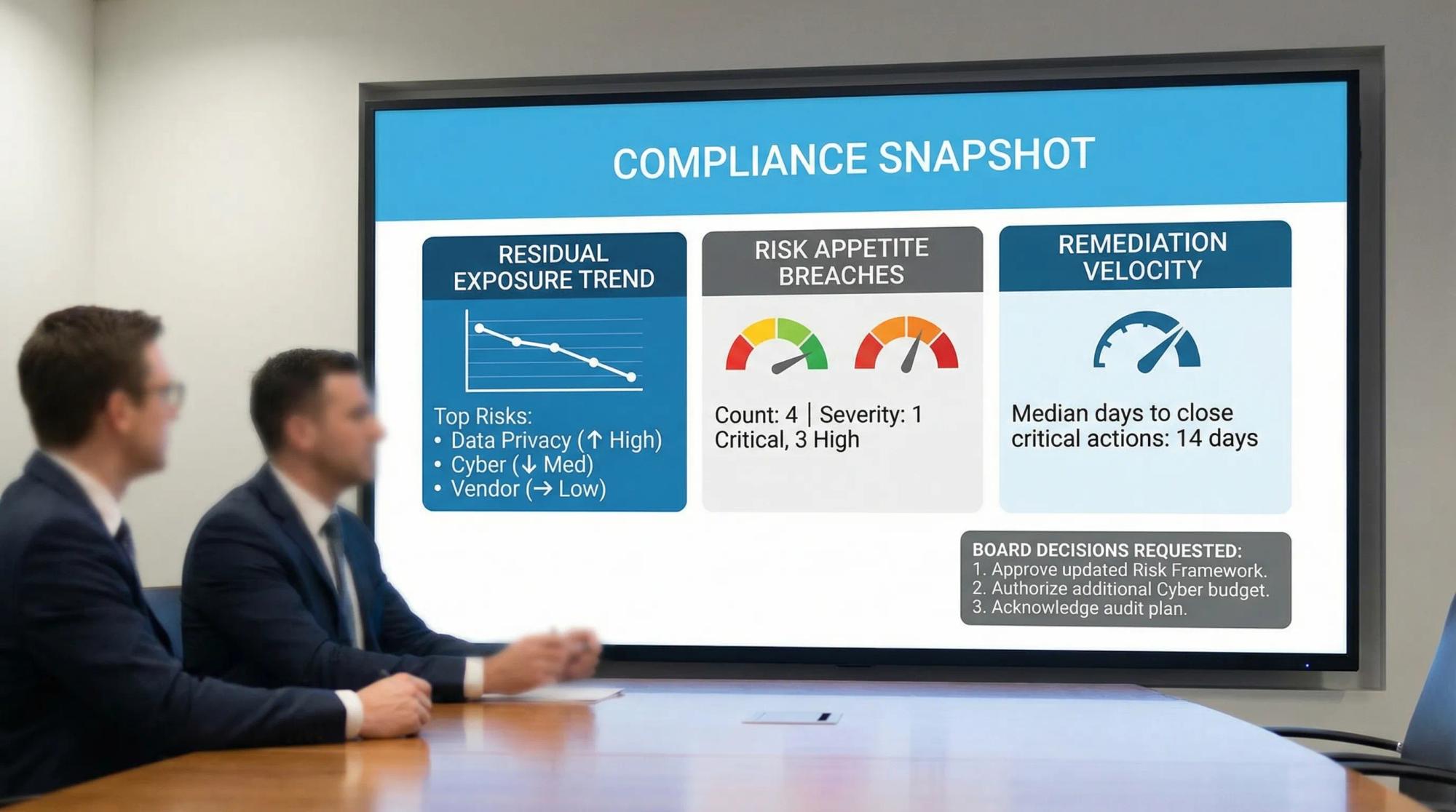
Give me one page, and I want it to answer four questions — fast:
1 What are we exposed to, right now? Not "what are the regulations." Actual exposure by business line, geography, third parties, products, and operating model.
2 What is our appetite, and where are we outside it? If the board never sets thresholds — or never sees breaches — they are not governing. They are observing.
3 Is it getting better or worse? Boards understand trend. They don't understand static snapshots.
4 What are we doing about it, and is it working? Action, ownership, timeline, proof.
That is compliance for the board.
Translating compliance work into board language
Three reframes the board pay attention to
Training Instead of: "92% completion rate." Say: "High-risk role coverage is 96%, and the remaining 4% is concentrated in procurement across two countries. Managers have been asked to enforce completion by date. We will test impact through scenario-based checks next month." Now it's about exposure, not e-learning.
Third-party due diligence Instead of: "We onboarded 240 vendors and reviewed 80." Say: "78% of spend is covered by risk-tiered due diligence. Six high-risk vendors are operating under interim controls pending remediation. New high-risk onboarding adds an average of nine days — acceptable within current appetite. If sales wants faster onboarding, the decision is either more automation or more risk." That's a business trade-off.
Policy updates Instead of: "We updated the gifts policy." Say: "We reduced exception requests by 30% by clarifying thresholds and embedding approvals into the workflow. Exceptions are now logged and monitored, so we can spot patterns by team and third party."
f you work with growth people, you’ve seen this discipline already: executives get a one-page funnel, not a novel. A good growth marketing and innovation partner will insist on clarity, metrics, and decision hooks. Compliance deserves the same respect.
The three metrics that change the conversation
You don't need ten metrics. You need three that force governance.
The trick: choose metrics that show effectiveness, not just activity.
Metric | What it tells the board | What you ask the board to decide | Typical inputs |
|---|---|---|---|
Residual exposure trend (top 5 risks) | Where the company is most exposed after controls, and whether that exposure is moving | Confirm priority areas and budget; accept or reject residual risk | Risk assessment outputs, control mapping, weighted residual scoring |
Risk appetite breaches (and near misses) | Where the business operated outside agreed thresholds, and whether detection is early or late | Set or adjust thresholds; agree on escalation rules and consequences | Exception logs, incident registers, approvals, monitoring flags |
Remediation velocity for critical gaps | Whether you close high-impact findings fast enough, and where ownership is weak | Approve deadlines, assign executive owners, remove blockers | Audit findings, control test results, remediation tracker, overdue rate |
A few implementation notes:
Residual exposure trend only works if you keep the scope stable. Don't rebuild the model every quarter — calibrate it once, then track movement.
Appetite breaches require defined appetite. If you don't have thresholds (for gifts, high-risk third parties, competition-sensitive meetings, AI system use cases), you will never have a clean signal.
Remediation velocity forces accountability — and forces you to stop treating "we're working on it" as an acceptable status.
This is also where official guidance gives you internal leverage. The
How real-time compliance data changes the dynamic
Quarterly reporting creates a predictable theatre: chase evidence, assemble slides, hope nothing blows up the week after the meeting.
Continuous visibility flips the relationship.
When compliance data is captured as work happens — approvals, attestations, third-party status, control evidence, remediation progress — the board conversation shifts from "tell us what you did" to "tell us what changed."
This is why we built Naltilia around automated data collection and compliance workflow automation. Not to generate prettier reports — but so you can stop spending two weeks producing a board pack and start spending that time challenging the business on real risk decisions.
It also matters for newer regimes where governance and traceability are not optional. The EU AI Act is a good example of where oversight, documentation, and lifecycle controls will become board-relevant faster than most teams expect.
the reframe: you are not a report producer
The board does not need your 60 pages. They need your judgment, backed by data.
Your job is not to educate directors on every regulation. Your job is to make risk legible, surface the trade-offs, and ask for decisions.
So here's the challenge.
At the next board meeting, bring one page. Bring three metrics. End with two explicit asks: the risk appetite you need them to set, and the resources or operational changes required to live within it.
If the board can't govern from that, the problem is not your slide design.
FAQ
Four objections, answered
"We already have a dashboard. What's different about this?"
Most compliance dashboards are reporting tools — they surface what happened after the fact. The shift we're describing is upstream: data captured as work happens, not assembled retrospectively. A dashboard fed by manual inputs two weeks before a board meeting is still a 60-page report in a different format. The question is not whether you have a dashboard. It's whether your board is seeing reality or a curated version of it.
"Our board doesn't have the appetite for this level of detail."
That's usually a sign the detail is wrong, not that the board is disengaged. Boards disengage from activity metrics because activity metrics don't require a decision. Present residual exposure, a threshold breach, and a remediation timeline with an owner — and ask for a call. You'll find the appetite.
"We don't have the data infrastructure to do this."
You don't need to solve everything at once. Start with one metric you can actually track cleanly — remediation velocity is usually the easiest, because the inputs already exist in most organisations. Build credibility with one clean number before you expand. The infrastructure question becomes easier to answer once the board has seen what good looks like.
"This is fine in theory, but our legal team will never sign off on a one-page board report."
The one-pager is not a replacement for the full compliance file — it's what goes in front of the board. The documentation, the legal commentary, the evidence pack: all of that still exists. You're not simplifying the program. You're simplifying the governance interface. Those are different things, and the distinction is usually enough to get legal comfortable.
If you're working through any of these objections right now, Naltilia can help — from automating the data collection that makes continuous visibility possible, to structuring the metrics that turn a board pack into a governance tool. Talk to our experts if you want to work through what this looks like for your program.