
Regulatory fines make headlines. Last year, antitrust authorities alone issued roughly $6.7 billion in penalties worldwide. But anyone who has lived through a serious regulatory incident knows that the fine is rarely the most expensive part.
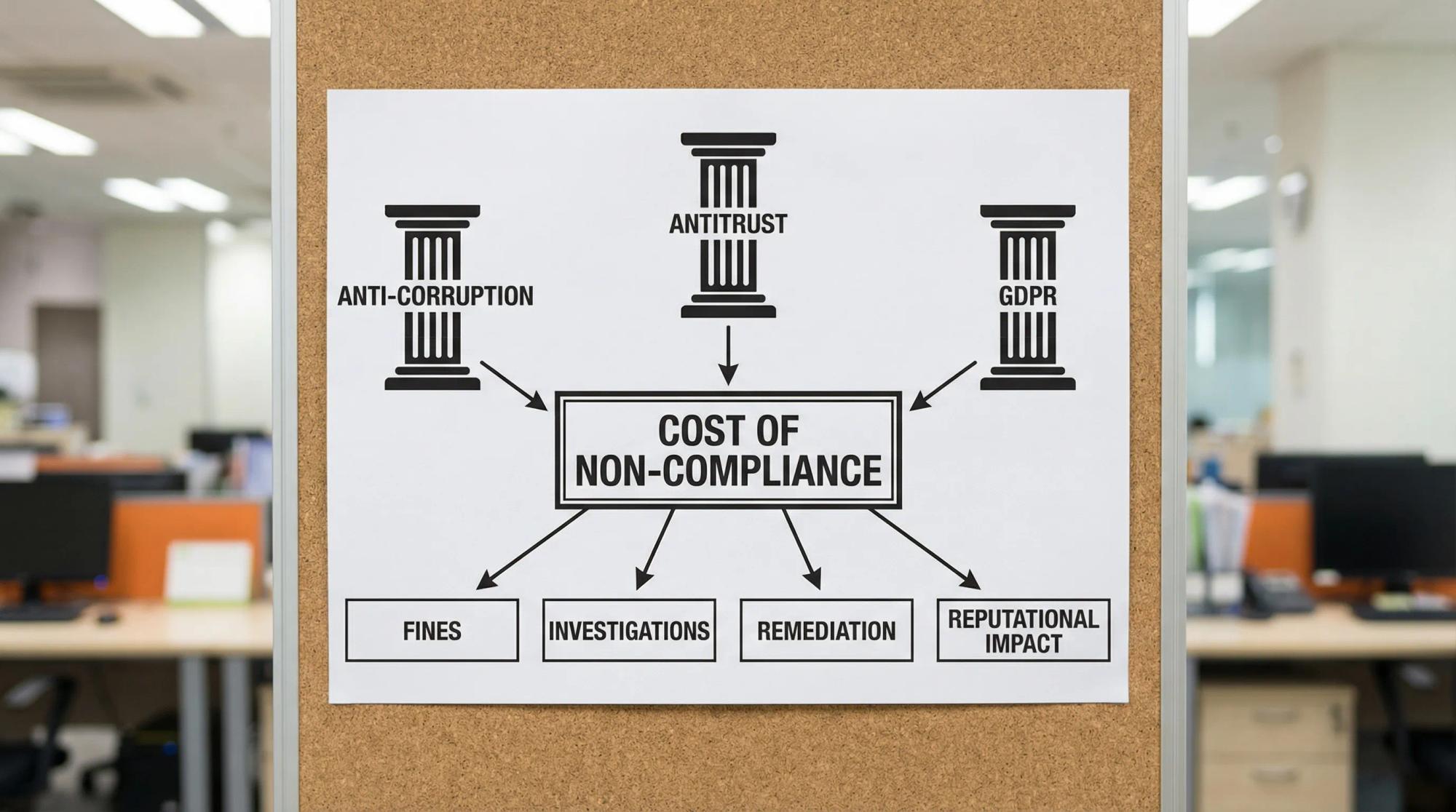
The real cost of non-compliance is a chain reaction. It starts with scrutiny, escalates into investigation, and then fans out into operational disruption, commercial damage, and reputational harm that takes years to repair. For leadership teams, the most punishing cost is often something that never appears on an invoice: the months of executive focus pulled entirely into response mode.
This article looks at what that chain reaction actually looks like — across anti-corruption, antitrust, and data protection — and at how a well-run compliance program either prevents it from starting, or limits the damage when it does.
The hidden multiplier: why the fine is only the first invoice
When boards model "regulatory risk," they tend to focus on the maximum fine. That is the wrong frame.
Enforcement actions generate costs across five distinct categories, each of which can exceed the penalty itself:
Cost category | What it looks like in real life |
|---|---|
External investigation and legal support | outside counsel, forensic e-discovery, translation, economic experts |
Internal disruption | paused projects, diverted executives, “do not delete” freezes, delayed deals |
Mandatory remediation | corrective action plans, policy rewrites, re-training, control redesign, monitoring |
Commercial consequences | debarment risk, tender exclusions, contract terminations, partner re-assessments |
Reputational and people costs | whistleblowing surge, attrition, hiring difficulty, management credibility loss |
These costs compound. They also arrive simultaneously — external counsel bills while executives are distracted, while partners are pausing contracts, while your best people are updating their CVs.
Corruption: the price of a bribe
What enforcement actually looks like
Anti-corruption investigations rarely stay narrow. A single incident — a payment made through a third-party intermediary, a hospitality arrangement that crossed a line — typically becomes an entry point for regulators that may end up discovering a larger corruption scheme.
The Airbus settlement, announced in early 2020, is instructive. The resolution spanned three jurisdictions — France, the UK, and the US — and the financial penalty exceeded €3.6 billion. But the more durable cost was the remediation obligation: years of external monitoring, systematic overhaul of third-party processes, and an organization-wide compliance transformation program. The fine was a single invoice. The remediation was a multi-year operating burden.
Beyond the financial penalty, enforcement consistently triggers:
- Withdrawal from certain markets or business lines during investigation
- Loss of government contracts or eligibility for public tenders
- Senior management changes demanded or signaled by regulators
- Coverage that surfaces during future commercial due diligence, affecting M&A and partnership discussions for years
Where bribery most often enters the business
Enforcement patterns reveal a consistent set of entry points — not exotic schemes, but business-as-usual channels where controls are weak:
- Third-party intermediaries (agents, distributors, customs brokers) acting with limited oversight
- Gifts, hospitality, and travel with no meaningful approval or documentation trail
- Contracting under time pressure, where due diligence steps are skipped
- Accounting classifications — "miscellaneous," "marketing," "consulting" — that prevent meaningful review
The recurring lesson from multi-jurisdictional settlements is not that companies built bribery into their strategy. It is that bribery entered through normal business channels because the controls designed to block it were not operating consistently in practice.
Antitrust: When Normal Conversations Become a Case
The scale of sanctions
Competition enforcement has grown significantly both in ambition and in the size of individual penalties.
In March 2024, the European Commission fined Apple over €1.8 billion in connection with conduct related to music streaming. In April 2025, the Commission fined a group of car manufacturers for coordinating for over 15 years to avoid paying for recycling services — agreeing not to compete on advertising their cars' recyclability and remaining silent on recycled materials used in new cars. These are not outliers — they reflect an enforcement environment where a single commercial decision, or a single conversation, can generate a significant penalty.
For companies, the risk is not just the size of potential fines — it is the cost of surviving a multi-year investigation while running a business. Dawn raids, document requests, executive interviews, and compliance with investigation timetables consume internal resources at precisely the moment when strategic execution matters most.
What triggers an investigation
The most common misunderstanding about antitrust risk is that it requires deliberate misconduct. Competition cases frequently begin with information flows — what employees share, what they receive, and what their organization subsequently does.
The UK's Competition and Markets Authority fined a group of banks for sharing sensitive information about UK government bonds through private chat channels. No secret meetings. No formal cartel. Conversations that moved from market color to price-sensitive territory, in formats that felt informal but were treated by regulators as evidence.
Common triggers include:
- Trade association meetings where discussions drift beyond the agenda
- Benchmarking exercises that touch on current pricing or capacity
- Private message threads between contacts at competing organizations
- Distributor conversations that involve coordination on customer allocation or pricing
The commercial consequence that rarely gets modeled
Beyond fines, competition investigations create a specific commercial problem: they happen in public. Customers, suppliers, and partners follow the process. A company under active antitrust investigation is a less attractive counterparty. Long-term supply agreements, joint venture discussions, and government contracts are all affected — often before any outcome is reached.
GDPR: When Data Protection Becomes a Business Continuity Issue
The enforcement reality
GDPR enforcement is now mature. Regulators have moved beyond first-generation cases about notices and cookie banners, and are increasingly focused on operational proof: can you demonstrate lawful basis, data minimization, security governance, and controlled cross-border data flows?
Two 2024 cases illustrate what this looks like at scale.
Ireland's Data Protection Commission fined LinkedIn €310 million, citing failures in lawful basis and transparency obligations. The Dutch Data Protection Authority fined Uber €290 million for cross-border transfer violations involving data routed to the United States without adequate safeguards in place.
Neither case turned on a dramatic security breach or a clearly visible consumer harm. Both turned on structural failures in how data governance was designed and evidenced.
What makes GDPR incidents expensive beyond the fine
GDPR enforcement creates a specific compounding problem: the same failures that generate a fine also generate remediation obligations that restructure how your business operates.
A systemic failure in lawful basis mapping does not produce a fine and a quick fix. It produces an investigation, a fine, a corrective action plan, and then a period of elevated regulatory scrutiny during which every subsequent data-related decision receives additional attention. Organizations that have been through significant GDPR enforcement describe years, not months, of operating in an elevated compliance posture — with the associated costs in legal advice, internal resource, and management bandwidth.
There are also downstream commercial effects. Significant GDPR findings surface in enterprise procurement processes, where customers and partners increasingly conduct data protection due diligence before signing. A major enforcement decision becomes a reference point in sales conversations for years.
How a Compliance Program Changes the Equation
The business case for investing in compliance has two distinct parts, and both matter.
Part one: Prevention
A well-designed compliance program reduces the probability that an infringement occurs in the first place — not by creating policies, but by putting friction in the specific places where violations most often enter the business.
For anti-corruption, that means proportionate third-party due diligence, functioning approval processes for gifts and hospitality, and accounting controls that surface unusual payments before they are buried in a reporting period.
For antitrust, it means role-specific guidance that gives salespeople, procurement teams, and executives clear decision rules in the moments of highest risk — a trade association meeting, a call with a distributor, a conversation that drifts into pricing territory.
For data protection, it means repeatable governance around processing activities: a records of processing inventory that is maintained, lawful basis that is mapped and tested, vendor controls that operate in practice rather than on paper.
Programs that prevent infringements share a common characteristic: they focus controls on high-risk touchpoints in the actual business model, not on generic training that covers everything equally.
Part two: Mitigation
When something does go wrong, the quality of your compliance program determines how badly it compounds.
Regulators across jurisdictions weigh cooperation, speed of detection, and quality of pre-existing controls when deciding how to proceed and what remediation to require. An organization that can demonstrate it had functioning controls, identified the issue through its own processes, and responded promptly is in a materially different position from one that cannot reconstruct what happened or why its controls did not prevent it.
In practical terms, this means that a compliance program built to mitigate impact needs to do three things well:
- Create traceable decision-making — approvals, escalations, exceptions, and the rationale behind them, documented in a way that can be reproduced under a regulator's document request
- Enable fast containment — functioning incident processes that move from detection to response without the delay caused by unclear ownership or incomplete records
- Support a defensible narrative — the ability to explain what controls existed, what failed, how quickly it was detected, and what changed to prevent recurrence
Organizations that handle enforcement well are rarely those that avoided all risk. They are those who built programs that let them respond credibly, quickly, and with evidence.
The Practical Gap: Design vs. Execution
The most common compliance weakness is not the absence of controls — it is the gap between controls that exist and controls that operate consistently.
Most organizations can describe their third-party due diligence process. Fewer can show, for a specific high-risk onboarding from the past quarter, exactly who approved what and why, what red flags were raised and how they were resolved, whether required contractual clauses were included, and whether invoice review against deliverables actually happened.
The same gap appears in GDPR programs: a records of processing inventory exists but has not been updated following a new product launch; vendor DPAs are in place but sub-processor changes are not tracked; data subject access request SLAs are defined but the case log does not support them.
That gap — between policy and proof — is where most regulatory exposure actually lives. And it is where automation makes the most measurable difference: not in writing better policies, but in making controls traceable, consistent, and verifiable at the moment they matter.
Frequently Asked Questions
Q: We have compliance policies in place. Is that enough to protect us from regulatory risk?
Policies are a starting point, not a defense. Regulators across anti-corruption, antitrust, and GDPR consistently make the same distinction: the existence of a policy and the consistent operation of controls are two different things. What gets organizations into trouble — and what determines how badly an investigation compounds — is the gap between what the policy says and what actually happened in practice. The question regulators ask is not "do you have a policy?" but "can you show it worked?"
Q: What's the most common compliance failure that leads to an anti-corruption investigation?
The most recurring pattern is not deliberate wrongdoing — it's bribery entering through normal business channels because controls were not functioning consistently. Third-party intermediaries acting with limited oversight, hospitality and travel with no approval trail, contracts signed under time pressure without due diligence: these are the entry points. The investigation often starts with a single incident and quickly becomes an assessment of your entire program. The question shifts from "did this happen?" to "why didn't your controls prevent it?" — and that second question is far more expensive to answer.
Q: Our sales team interacts with competitors at trade associations regularly. How much antitrust risk does that actually create?
More than most teams realize. Competition cases frequently begin not with a formal cartel agreement but with information flows — what employees share, what they receive, and what the organization subsequently does with it. A trade association meeting with a loose agenda, a one-to-one conversation where "market color" drifts into pricing territory, a private message thread with a contact at a competing firm: these are the documented triggers of enforcement actions. The practical answer is that anyone in sales, procurement, pricing, or leadership who has regular contact with competitors needs clear, scenario-specific guidance — not a general reminder to "be careful."
Q: GDPR has been in force since 2018. How is it still generating nine-figure fines?
Because enforcement has matured beyond first-generation issues. Regulators are now focused on operational proof: can you demonstrate lawful basis consistently across all your processing activities? Are your cross-border transfer safeguards actually in place and documented? Does your vendor ecosystem have functioning controls, or just signed agreements? The LinkedIn €310 million and Uber €290 million decisions in 2024 both turned on structural failures in governance — not on a visible breach or consumer harm. The organizations that continue to generate large GDPR exposure are typically those with systemic gaps between what their privacy program says on paper and what operates in practice.
Q: What does "good" look like for a compliance program in practical terms?
Three things distinguish programs that actually work from programs that exist on paper. First, they focus controls on the specific high-risk touchpoints in the business model — the third-party onboardings, the competitor-adjacent conversations, the cross-border data flows — rather than covering everything generically. Second, they create traceable decision-making: approvals, escalations, exceptions, and the reasoning behind them, documented in a way that can be reproduced under a regulator's document request. Third, they learn and adapt after incidents, audits, or near-misses, rather than treating compliance as a one-time design exercise. The practical gap for most organizations is not in the design of their program. It's in the consistency of execution and the quality of the evidence trail.
How Naltilia Can Help
Designing a compliance program is the straightforward part. The harder problem — the one that determines whether a program actually protects your organization — is making it operate consistently and producing evidence that it did.
That is where most teams run into friction. Risk maps updated manually and falling out of date. Control tests living in inboxes rather than a traceable system. Remediation actions tracked in spreadsheets with no clear ownership. Evidence packs assembled under pressure when a regulator asks, rather than maintained as a matter of course.
Naltilia is built specifically for that execution problem. It helps compliance teams move from static documentation to a living operating system for their program — across anti-corruption, antitrust, and data protection.
Living risk maps that reflect your actual business model and update when it changes, rather than a point-in-time assessment that is already stale by the time it is signed off.
Control-to-evidence traceability so that for any control in your program, you can show what it is designed to do, whether it operated as intended, who tested it, and what the outcome was — without reconstructing that picture from multiple systems under pressure.
Workflow-driven remediation that assigns ownership, tracks progress, and creates an audit trail of what was identified, what was done in response, and when — giving you a defensible record of continuous improvement rather than a compliance snapshot.
Standardized evidence requests that replace ad hoc chasing across email threads with a structured, repeatable process — so that evidence collection is consistent, complete, and proportionate to the risk being managed.
The organizations that handle regulatory scrutiny well are not those that avoided all risk. They are those who can respond quickly, completely, and with evidence. Naltilia is designed to make that possible.
Ready to see it in action? Book a 30-minute demo and we'll walk through how Naltilia maps to your current compliance operating model and where automation makes the most immediate difference.