
Every compliance leader sees the same curve: more laws, broader stakeholder expectations, and fewer hours in the week. By 2030, the programs that consistently meet objectives will look different. They will run on data, not documents, and they will turn analytics into timely decisions that people across the business can act on.
Recent research on the future of compliance points to a set of shifts already underway, from high level, intermittent oversight to granular, predictive and personalized programs. The question for intermediate-sized enterprises is how to translate those ideas into practical, right sized moves that improve outcomes across anti bribery (ISO 37001 and Loi Sapin II), criminal compliance in Spain (UNE 19601), antitrust (UNE 19603), AML, and the AI Act.
This article distills those shifts with a single lens, how better data helps you achieve compliance objectives with evidence of effectiveness.
What data first compliance looks like in practice
A data first program is not a bigger library of policies. It is an operating model where critical workflows produce structured signals that can be monitored, explained and improved. Five properties matter most:
- Unified obligation and risk inventory, a single, living map of obligations and risks across domains like Sapin II, ISO 37001, UNE 19601, UNE 19603, AML and the AI Act.
- Automated data collection that evidences control performance, exceptions and outcomes.
- Granular analytics, algorithms and rules that detect risk at the level of a transaction, counterpart, market, model, or employee decision.
- Embedded touchpoints, guidance and approvals delivered inside the workflow where choices are made, not in a separate portal.
- Trust metrics, measures of fairness, transparency and speak up confidence that go beyond process ticks to show programs work in the real world.
Gartner’s research on 2030 program design highlights 10 shifts that line up with this model, moving from one size fits all and backward looking activities to tailored and predictive ones. Regulators are pointing the same way. The U.S. Department of Justice’s 2023 update to its Evaluation of Corporate Compliance Programs asks for data driven testing, timely remediation and incentives that reinforce desired behavior, not just paper policies.
Five data shifts to operationalize by 2030
1 Risk monitoring gets granular
Why it matters, top down KRIs rarely detect incidents in time to disclose, fix and learn. By 2030, you need line of sight to patterns and outliers at the level where risk actually happens.
Data to put in play, structured feeds on payments, gifts and hospitality, discounts and promotions, purchase orders and third party attributes, competition sensitive exchanges, AML alerts, and AI system events. Enrich with country risk indices and negative news.
Early use cases, bribery risk outlier detection under ISO 37001 and Sapin II, reseller discount anomalies for antitrust under UNE 19603, related party AML red flags, and model use exceptions for the AI Act.
2 Policy and training become personalized
Why it matters, generic guidance gets ignored. Personalized obligations by role, geography and exposure raise attention, reduce burden and improve adherence.
Data to put in play, HR data for roles, tenure and team; workflow data for the decisions people actually make; mapped obligations by framework and risk.
Early use cases, role based anti corruption obligations in high risk sales teams, tailored antitrust do and don’t guidance for commercial, procurement and association liaisons, AML role specific checklists for first line operations, and AI Act obligations tailored to provider or deployer roles.
3 Third party oversight uses shared data
Why it matters, questionnaires at onboarding miss fast moving risk. Sharing outcomes through peer networks or trusted brokers, where allowed, and augmenting with continuous signals improves both speed and accuracy.
Data to put in play, due diligence answers, beneficial ownership, sanctions screening, payment behavior, performance disputes, audit outcomes, and shared trust attestations when available.
Early use cases, dynamic risk scoring and remediation triggers for intermediaries in ISO 37001 or Sapin II programs, onboarding to renewal risk narrative for UNE 19601, and continuous screening against AML lists. For the AI Act, capture assurances from providers on data governance and human oversight.
4 Program review becomes continuous
Annual or quarterly reviews are too slow for volatile risk. Instrument your program so effectiveness metrics trigger improvements when results drift.
Data to put in play, control health telemetry, policy consumption, training quiz accuracy on scenario based items, culture pulse checks, and incident close out quality.
Early use cases, automatic escalation when control evidence is late or weak, retraining when scenario accuracy drops in a high risk team, or a review of competition guidelines when a market’s incident trend rises.
5 Predictive analysis complements root cause
Root cause analysis is necessary, but it is after the fact. Premortem analysis, structured foresight on where and how controls could fail, helps you shore up the riskiest gaps before they become cases.
Data to put in play, loss events, near misses, procedure exceptions and audit findings, combined with scenario assumptions for upcoming initiatives, new channels or partners.
Early use cases, premortems before entering a high risk market under ISO 37001, before joining a trade association under UNE 19603, before a new product launch with AML risk, or before deploying a general purpose AI tool under the AI Act.
Personalized touchpoints, powered by data
By 2030, compliance will win on relevance and trust. That requires measuring things most programs only describe qualitatively today.
- Speak up that is employee centric, track what people value, clarity of process, non retaliation outcomes and team benefits. The evidence shows employees are more likely to report when they believe reporting is fair and good for them and their teams. Measure perceived fairness and follow through on consequences consistently.
- Embedded prompts instead of portals, bring the do or do not into the form or system at the moment of decision. For antitrust under UNE 19603, embed a quick checklist in event and meeting workflows. For ISO 37001 and Sapin II, embed gifts and hospitality guardrails in expense systems.
- Consequences that reach everyone, align recognition and incentives with ethical behavior beyond senior levels. Track reinforcement rates and fairness across job levels and geographies.
- Investigations you can trust, add participant experience metrics to process metrics. Capture whether parties felt respected, heard and protected. Publish improvements year over year. Higher trust correlates with healthier reporting cultures.
A pragmatic data blueprint for intermediate sized enterprises
You do not need a data science lab to start. You do need a plan that lines up data, controls and decisions.
Near term, 0 to 90 days
- Create a unified obligations and risk register, map Sapin II or ISO 37001 risks, UNE 19601 offenses, UNE 19603 antitrust exposures, AML risks and AI Act duties to owners and data sources. If you need a starting model, see our guide to building a compliance risk map.
- Automate three high value evidence flows, one each for financial controls, third party due diligence and speak up follow up. Favor API or webhook integrations and prefilled attestations to reduce chasing. Our guide on automating evidence collection covers practical patterns.
- Pilot one analytics use case, choose a high volume workflow with quality data. Examples include gifts and hospitality anomalies, reseller discount outliers or continuous sanctions screening. Define how a human reviewer will triage and close.
- Add two trust measures, embed two short questions post investigation and post training to gauge fairness and relevance.
Next, 3 to 12 months
- Personalize policies and training for two high risk roles, for example, field sales in two high risk markets for ISO 37001, or procurement and marketing for antitrust under UNE 19603. Use workflow data to target guidance and reduce burden.
- Stand up third party continuous monitoring, refresh sanctions and negative news periodically and create clear remediation playbooks. For AML and anti bribery, connect refresh cadence to risk tier.
- Instrument program review, attach health metrics to core program elements, such as control coverage and on time evidence rate, training scenario accuracy and culture pulse response.
- Introduce premortems to change management, run a premortem before each high risk launch or market entry and document mitigations and owners.
Later, toward 2030
- Expand analytics across risk workflows, link detection and remediation data so you can report time to decision and recurrence rates.
- Share risk signals with peers and trusted brokers where appropriate and lawful, especially for third party risk.
- Evolve compensation and recognition to reinforce desired behaviors consistently across levels, regions and functions, with metrics that show fairness.
Guardrails for AI, privacy and fairness
Data only helps if collected and used responsibly.
- Privacy and minimization, collect only what is needed to evidence control performance and risk decisions. Apply data retention aligned to legal requirements, especially in AML.
- Transparency, keep model and rule logic explainable. For the AI Act, document data sources, risk ratings and human oversight.
- Human in the loop, analytics should surface signals, people should decide. Document triage and remediation decisions and why they were taken.
- Security, protect evidence stores and investigation data with least privilege access and audit trails.
- Equity and geographic nuance, personalize guidance and incentives with care. What works in one country may backfire in another.
How Naltilia helps you operationalize the 2030 data plan
Naltilia is an AI powered platform for business compliance management. We focus on turning obligations and risks into observable, automatable workflows that scale a small team’s capacity.
- Regulatory risk assessment, build a unified risk inventory, align to Sapin II, ISO 37001, UNE 19601, UNE 19603, AML and the AI Act, and prioritize where analytics and controls matter most.
- Automated data collection, connect to systems to collect control evidence and operational signals with less manual chase.
- Tailor made policies, generate role specific policy guidance and training assets that reduce burden and improve relevance.
- Remediation actions, turn findings and red flags into assigned, tracked tasks with clear owners and deadlines.
Metrics that will matter to leadership
Show progress with a small set of metrics that tie directly to objectives and frameworks:
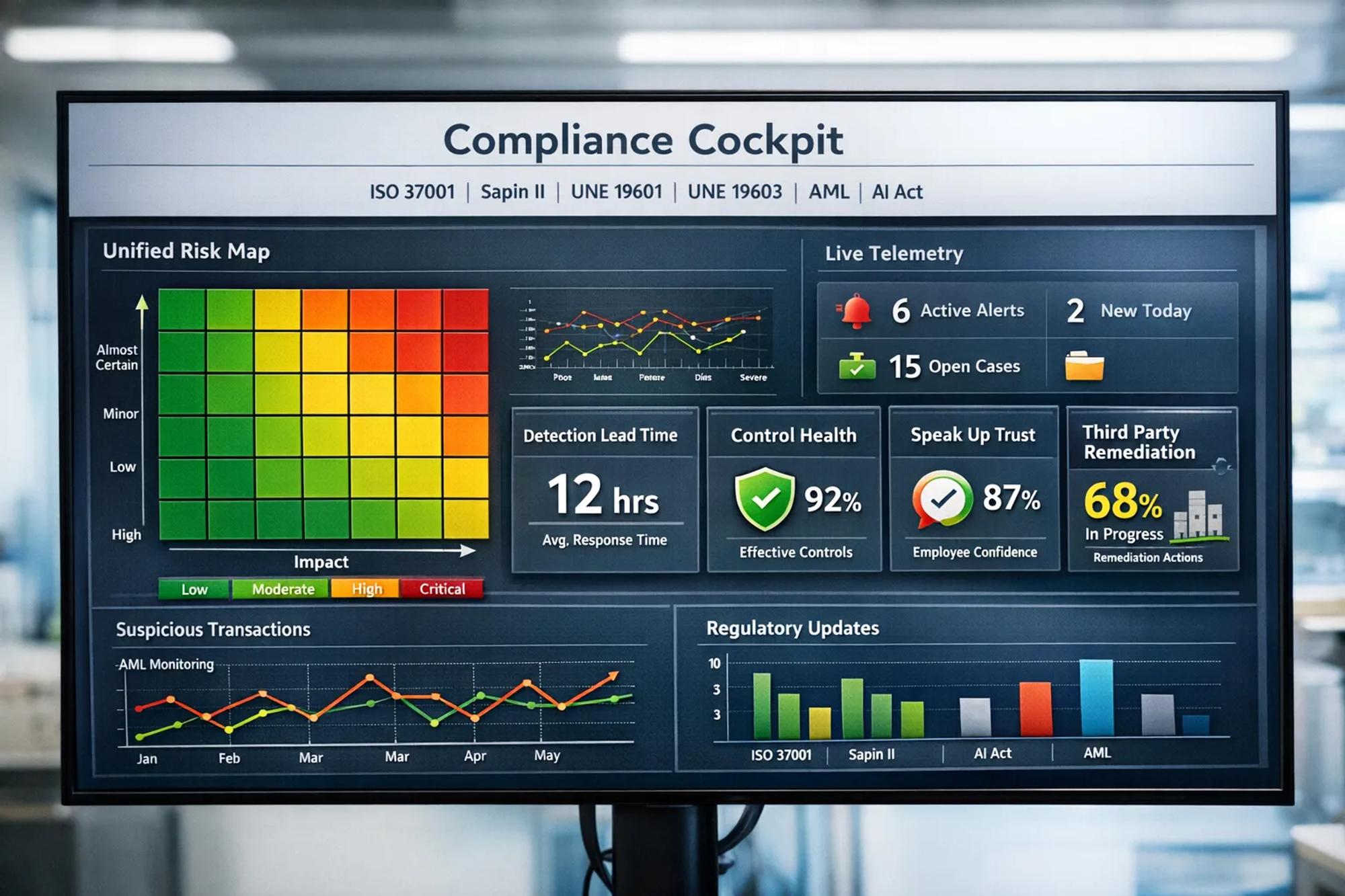
- Detection lead time by risk category.
- On time, high quality evidence rate for key controls.
- Post decision accuracy on scenario based training.
- Third party remediation lead time and pre impact resolution rate.
- Speak up and investigation trust scores over time.
- Percentage of high risk workflows with a premortem and implemented mitigations.
By 2030, the most credible compliance programs will be those that can show, with data, that they prevent, detect and respond in time. Getting there does not require a moonshot. It requires a plan to collect the right signals, embed the right touchpoints and continuously learn. If you are ready to make that shift, we would be glad to compare notes on your landscape and priorities.
References and further reading
- Gartner, insights for legal and compliance leaders on program effectiveness and the future of compliance 2030 (overview): https://www.gartner.com/en/legal-compliance
- U.S. Department of Justice, Evaluation of Corporate Compliance Programs (2023 update): https://www.justice.gov/criminal-fraud
- European Commission, the EU approach to artificial intelligence and the AI Act: https://digital-strategy.ec.europa.eu/en/policies/european-approach-artificial-intelligence
- European Commission, anti money laundering and countering the financing of terrorism: https://finance.ec.europa.eu/anti-money-laundering-countering-financial-terrorismen
Related Naltilia resources
- AI Act readiness, compliance management that scales: https://www.naltilia.com/resources/blog/ai-act-readiness-compliance-management-that-scales
- Compliance risk mapping, the complete guide: https://www.naltilia.com/resources/blog/compliance-risk-mapping-the-complete-guide-for-companies
- How to automate evidence collection for controls: https://www.naltilia.com/resources/blog/how-to-automate-evidence-collection-for-compliance-controls-and-get-people-to-answer
- From red flags to trust, vendor risk management: https://www.naltilia.com/resources/blog/from-red-flags-to-trust-vendor-risk-management
- Compliance control monitoring, a case study: https://www.naltilia.com/resources/blog/compliance-control-monitoring-a-case-study