
Compliance turns into a profit driver when it does three things at once: it prevents avoidable loss, it accelerates revenue, and it produces decision-grade evidence that leaders and customers can trust. If your program is mostly policies, spreadsheets, and quarter-end evidence chases, you are paying for compliance without capturing its full value.
A strategic guide for mid-sized companies ready to make compliance work for them, not against them.
Below are 10 concrete shifts that compliance officers and legal teams can implement to move from “cost center” to “business enabler”, while staying aligned with real expectations under frameworks like France’s loi Sapin II (and AFA audit practice), ISO 37001, and Spain’s UNE 19601 and UNE 19603.
A 2-minute diagnostic: where are you today?
Use this quick decision table to pick the 2 to 3 shifts you should start with (and to explain the priority to leadership).
symptom you see | what it usually means | start with | what “better” looks like (proof) |
|---|---|---|---|
you have policies, but cannot show consistent adoption | “paper compliance” | point 5 and 8 | evidence of use, testing, remediation closed-loop |
sales escalates compliance late, deals stall in procurement | compliance is not embedded in revenue workflows | point 3 and 9 | a repeatable trust pack, faster due diligence cycles |
you can describe risks, but your risk map is outdated | risk mapping is static, not operational | point 2 and 7 | a living risk map linked to controls and events |
audits are a fire drill | evidence is not designed, collected, and stored by default | point 5 and 10 | audit-ready evidence available on demand |
leadership sees compliance as overhead | value is not quantified and communicated | point 1 and 4 | cost-of-non-compliance model and board-grade KPIs |
1 Reframe compliance as a financial safeguard, not an overhead line
If compliance is only presented as a budget line, it will be managed like a cost. Reframe it as a financial safeguard that protects EBITDA, cash flow, and deal capacity.
A widely cited benchmark in compliance ROI discussions is that the cost of non-compliance can be 2.5 to 4 times the cost of compliance, once you include remediation, disruption, and lost business, not only fines. The exact multiplier varies by sector and incident type, but the direction is consistent: reactive spending is structurally more expensive than preventive controls.
Practical move: build a simple “risk to money” narrative for the CFO and board.
Template: loss channels your leadership already understands
loss channel | what it looks like in reality | what you can evidence |
|---|---|---|
regulatory response | investigations, dawn raids, supervisory measures | response playbooks, documented controls, testing history |
legal exposure | defense costs, settlements, contractual disputes | decision records, contract clauses, due diligence files |
operational disruption | stopped projects, rework, emergency training, vendor replacement | remediation logs, timelines, owner accountability |
commercial impact | failed tenders, delayed onboarding, churn | win/loss reasons, procurement questionnaires |
capital impact | financing friction, valuation haircut in M&A | diligence findings, closure conditions, representations |
If you can connect even one high-risk exposure to a credible cost narrative, compliance stops being “insurance theater” and becomes portfolio risk management.
2 Align compliance directly with business strategy (treat it as regulatory intelligence)
Compliance that arrives at the end of a project feels like friction. Compliance that participates at the start functions as real-time regulatory intelligence.
This is especially true for mid-sized companies operating across France and Spain, where expectations may converge in principle (risk-based programs, effectiveness, traceability) but differ in artifacts, language, and audit style. For example:
- Under loi Sapin II, Article 17 defines core anti-corruption program building blocks, and AFA audits focus heavily on risk mapping, control design, and evidence of effectiveness. See the official law text on Légifrance and AFA materials on the AFA website.
- Under ISO 37001, you are expected to run an anti-bribery management system with risk determination, controls, monitoring, and continual improvement (see ISO 37001 overview).
- Under Spain’s UNE 19601 and UNE 19603, effectiveness and traceability also matter, with practical emphasis on governance, risk analysis, and operational controls.
Step-by-step: build a regulatory intelligence loop
- Step 1: map strategic moves for the next 12 months (new markets, products, distribution channels, public tenders, acquisitions).
- Step 2: for each move, list “regulatory gates” (authorizations, certifications, customer requirements, third-party constraints).
- Step 3: assign an owner for each gate (business and compliance), with a target date.
- Step 4: store the decision trail (assumptions, interpretation choices, residual risk acceptance).
Outcome: compliance is no longer a retrospective reviewer, it becomes part of strategic planning and reduces uncertainty.
3 Use compliance transparency as a customer trust signal
In many sectors, the commercial question is not “are you compliant?” but “can you prove it fast enough to be onboarded?”
In B2B, enterprise procurement increasingly runs formal due diligence for third parties, including policy checks, control descriptions, and evidence of implementation. In B2C, compliance failure becomes brand damage, and reputational recovery is slow and expensive.
Practical move: treat transparency as a product, a “trust pack” that reduces friction.
Checklist: your audit-ready customer trust pack
- a short compliance program overview (scope, governance, escalation)
- your code of conduct and key policies (anti-corruption, AML, conflicts of interests, competition as relevant)
- a summary of your risk assessment approach (what risks you map, how often, who approves)
- third-party due diligence approach (risk tiers, remediation actions)
- speak-up and investigations process (intake, triage, non-retaliation stance)
- training approach (role-based, tracked, refreshed)
- evidence samples (a real control test report, a remediation log extract, an anonymized case summary)
This is not marketing material. It is operational proof. Build it once, maintain it quarterly, and your sales cycle benefits immediately.

4 Quantify the real cost of non-compliance (not just the headline fine)
Headlines focus on fines. Boards should focus on the full liability picture, because the indirect costs can outweigh penalties.
Practical move: maintain a living cost-of-non-compliance model for your top risk themes (anti-corruption, competition/antitrust, criminal compliance, third-party risk).
Template: cost-of-non-compliance model (keep it simple)
risk scenario | direct costs | indirect costs | “business choke points” | existing controls | residual gap |
|---|---|---|---|---|---|
corruption via intermediary | fines, defense, settlements | tender debarment, contract termination, management distraction | public procurement, permits | due diligence, approvals, accounting controls | monitoring and evidence gaps |
competition-sensitige information exchange | fines, dawn raid costs | reputational loss, commercial constraints, internal disruption | trade associations, pricing meetings | training, meeting rules | weak detection and decision records |
weak whistleblowing handling | sanctions, litigation | talent loss, culture decay, repeated incidents | HR trust, local management | channel exists | triage, confidentiality, follow-up |
Two important disciplines make this credible:
- separate inherent exposure (what could happen) from residual exposure (after controls)
- document assumptions and update after incidents, audits, near-misses, or regulatory changes
This becomes a decision tool, not a one-off budget argument.
5 Embed compliance into operations (policy vs process vs compliance-by-design)
Many companies have policies. Fewer have processes that make compliance the default. The most mature teams build compliance-by-design into workflows.
A practical distinction that auditors also care about
level | what it is | typical failure mode | what “effective” looks like |
|---|---|---|---|
policy | rules and expectations | nobody uses it, or it is too generic | policy is specific, owned, trained, and testable |
process | steps embedded into operations | steps exist, but no evidence or ownership | operational owner, clear checkpoints, repeatable outputs |
compliance-by-design | compliance requirements included at design time | retrofitting after launch | compliance gates in project and product lifecycles |
AFA practice under loi Sapin II (and management system standards like ISO 37001) pushes in the same direction: effectiveness over existence.
Practical move: define your “key controls” and make them testable.
Checklist: control design vs control effectiveness testing
- control design
- effectiveness testing
If you want a deeper operational method, Naltilia’s guide on building audit-ready evidence collection is a useful complement.
6 Leverage compliance knowledge for market expansion
Regulatory expertise is often underused. In regulated markets, it can be a growth asset.
Practical move: treat market entry as a compliance-enabled project, not a late-stage legal review.
Decision tree: should we enter a new market now?
question | if yes | if no |
|---|---|---|
do we know the licensing, authorization, or tender prerequisites? | build the plan and timeline | run a 2-week regulatory scoping sprint |
do we have operational owners for local obligations? | proceed with owners and evidence plan | define ownership before committing |
can we produce customer-facing trust artifacts quickly? | accelerate sales motion | build the trust pack first |
can we monitor and evidence controls post-entry? | reduce “retrofit tax” | design monitoring before launch |
Outcome: compliance reduces uncertainty and “retrofit cost,” which improves speed to revenue.
7 Package compliance intelligence as business insight
Compliance teams sit on signals that can improve operations: recurring control failures, bottlenecks in approvals, vendor risk concentrations, hotspots in complaints and speak-up.
The shift is to translate these signals into decision-grade insight for leaders.
Table: from compliance data to business decisions
compliance signal | what it might really indicate | business decision it can inform |
|---|---|---|
repeated exceptions in gifts and hospitality approvals | unclear thresholds, weak manager coaching | simplify rules, adjust incentives, targeted training |
high third-party risk in one region | vendor selection pressure, poor onboarding | change sourcing strategy, add contractual controls |
speak-up reports cluster in one business unit | leadership behavior issue, psychological safety gap | leadership intervention, governance changes |
frequent late-stage deal escalations | no front-end screening in sales | create a deal desk intake gate |
Practical move: pick 5 metrics that show effectiveness, not activity. If you need a metric menu, Naltilia’s article on board-level compliance dashboard metrics can help you choose KPIs that leadership understands.
8 Adopt a proactive compliance culture (not reactive firefighting)
Most major failures have warning signs: near-misses, audit findings, employee concerns, customer complaints. The difference between resilient programs and fragile ones is whether the organization treats early escalation as valuable.
Practical move: operationalize “proactivity” through routines, not slogans.
Checklist: practical culture levers that create audit-ready proof
- leadership behaviors
- speak-up trust
- training that avoids fatigue
- recognition and incentives
Culture becomes a profit driver when it reduces incident frequency and increases speed of safe decision-making.
9 Build a true partnership between compliance and revenue teams
The most expensive model is adversarial: sales pushes, compliance blocks, leadership arbitrates late, and everyone loses time.
Practical move: build a business partnering model with shared workflows.
A lightweight operating model that works in mid-sized companies
- create a weekly “deal and partner risk” slot (30 minutes)
- define a standard intake for escalations (who, what, jurisdiction, third parties, red flags)
- agree on response SLAs (what compliance can answer in 24h, 72h, 10 days)
- create pre-approved playbooks for common scenarios (gifts, agents, distributors, data access)
The key is dual literacy:
- compliance learns the revenue model and operational constraints
- revenue teams learn enough compliance logic to escalate early and accurately
Outcome: fewer late-stage surprises, faster onboarding, less friction, and better evidence if decisions are reviewed.
10 Harness AI-native compliance platforms (without losing defensibility)
All the shifts above require capacity, and mid-sized companies rarely have enough compliance headcount to do strategy, monitoring, evidence collection, remediation tracking, and reporting at once.
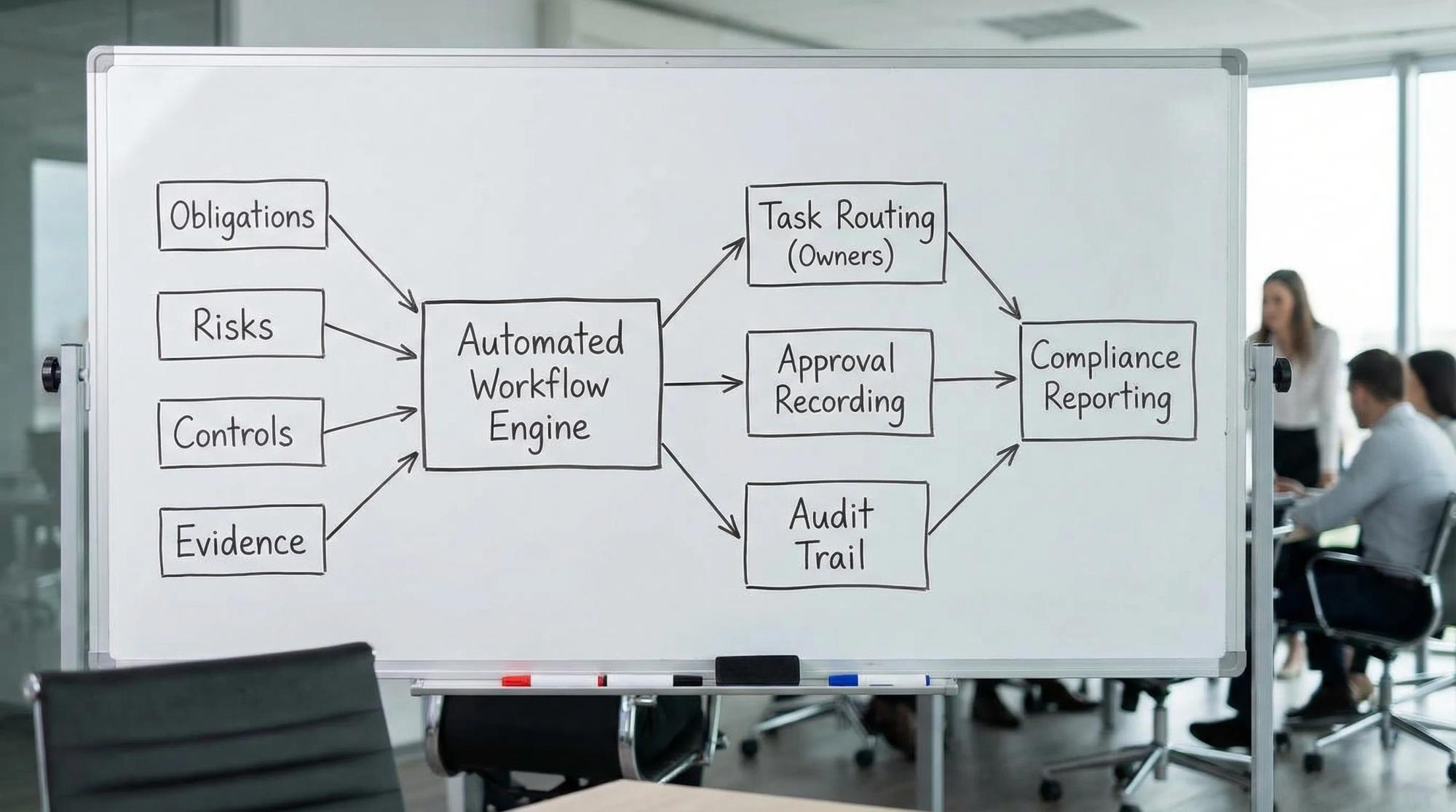
AI-native compliance platforms can change the economics by automating operational workload such as data collection, workflow routing, and documentation, while keeping human judgment for risk decisions.
Practical move: start with automation that increases defensibility.
Checklist: what to automate first (high value, low controversy)
- automated evidence collection for repeatable controls
- remediation action tracking with owners and deadlines
- structured regulatory risk assessment workflows
- policy lifecycle management with version control and attestations
Governance note (important)
If you use AI for compliance work, design for auditability: document inputs, decisions, approvals, and exceptions. Treat AI outputs as drafts unless your process defines validation steps and accountability.
Frequently asked questions
How do I prove compliance effectiveness, not just that we have policies? Tie risks to key controls, define evidence outputs for each control, test effectiveness on a cadence, and track remediation to closure. Auditors and regulators respond to traceable loops.
Which comes first, the risk map or control testing? Start with a risk map that is good enough to prioritize (not perfect), then define a small set of key controls for the highest risks. Testing and incidents should feed back into the next risk map update.
How do we stop audits from turning into a quarterly fire drill? Design evidence at control level (what artifact is created, where it is stored, who owns it), then automate collection where possible. “Audit readiness” is mostly an operating system problem.
What is the fastest way to reduce sales friction caused by compliance? Build a standardized trust pack and a simple deal escalation intake, with agreed response timelines. Most friction is created by late escalations and missing evidence.
Does ISO 37001 or UNE certification automatically make compliance a profit driver? Certification can help with trust and procurement, but only if the system is lived. The profit-driver effect comes from operational embedding, evidence, and decision speed, not from a certificate alone.
How naltilia can help
If your bottleneck is operational capacity, Naltilia’s AI-powered platform supports compliance teams with structured regulatory risk assessment, remediation actions, tailor-made policies, automated data collection, and compliance workflow automation. The goal is to reduce manual chasing and make core compliance work traceable, so your team can spend more time on judgment, business partnering, and effectiveness.
If you want to discuss a pragmatic path for your organization, you can contact Naltilia.
This article is general information, not legal advice.