
On International Anti-Corruption Day, December 9, 2025, one fact deserves to be front and center. Corruption is not abstract. It drains budgets, warps markets, weakens democracies, and quietly undercuts the conditions that allow organizations and people to thrive.
According to the United Nations, corruption represents more than 5 percent of global GDP, amounting to over 2.6 trillion dollars every year. The World Bank has estimated that businesses alone pay over 1 trillion dollars in bribes annually. These are not just numbers. They translate into fewer schools and hospitals, reduced public investment, distorted competition, higher prices for consumers, and a chronic loss of trust that is far harder to rebuild than it is to lose.
Learn more from the United Nations Office on Drugs and Crime

Why integrity still matters
Integrity is not a slogan, it is operating discipline. In 2025, it is also a performance signal. Markets have learned that shortcuts are expensive. Ethical companies close deals faster, attract better partners, and maintain more resilient supply chains. Clean books, strong internal controls, and transparent third-party relationships reduce the noise in decision making and ensure leadership time is spent on growth, not damage control.
Why fighting corruption is a necessity for companies
Anti-corruption is no longer a nice-to-have or a paragraph in a code of conduct. It is a legal requirement, a business imperative, and a competitive advantage.
1 A legal obligation
Regulatory expectations are clear and increasingly harmonized around risk-based programs that include risk assessment, internal controls, training, due diligence, and continuous monitoring.
- United States: the Foreign Corrupt Practices Act requires accurate books and records and effective internal controls, with a long track record of extraterritorial enforcement.
- United Kingdom: the UK Bribery Act prohibits public and private bribery and commercial bribery, with no carve-out for facilitation payments.
- France: Loi Sapin II requires large companies to implement eight-pillar compliance programs, including corruption risk mapping, a code of conduct, third-party due diligence, accounting controls, training, and a whistleblowing channel.
- International standards: ISO 37001 provides a certifiable anti-bribery management system blueprint, widely adopted to structure policies and controls.
- Spain: UNE 19601 (criminal compliance) emphasizes risk-based governance, tone at the top, control design, and continuous improvement, which align with anti-corruption program elements.
For mid-market organizations that work with governments, listed companies, financial institutions, or cross-border supply chains, anti-corruption compliance is now a prerequisite to building trust and doing business.
2 A business imperative
Reputational risk is immediate. Investigations and press cycles move faster than traditional remediation. Lost opportunities and delayed tenders often cost more than fines. Customers and procurement teams increasingly seek evidence of real program maturity, not paper policies.
3 A strategic advantage
Ethical behavior is a proxy for management quality and operational resilience. Well-governed companies win procurement faster, secure better financing, and operate with fewer interruptions. Integrity is a competitive asset.
What good looks like in 2025
Different laws use different language, but the building blocks are consistent. A modern anti-corruption program should include the following components, each tied to well-known frameworks (e.g. FCPA, UK antibribery Act, ISO 37001, UNE 19601).
Component | Why it matters |
|---|---|
Risk assessment and mapping | Focuses resources on real exposure by country, sector, interaction with public officials, and transaction types |
Third-party due diligence | Screens agents, distributors, consultants, and suppliers before engagement and throughout the relationship |
Code of conduct and policies | Clarifies rules on gifts, hospitality, donations, sponsorships, conflicts of interest, and lobbying |
Accounting controls and books and records | Prevents off-book accounts and disguising of payments, enables auditability |
Training and certifications | Builds awareness and accountability, tailored to risk roles and geographies |
Speak-up and investigation | Encourages early detection and fair resolution with protection against retaliation |
Continuous monitoring and audits | Tests control design and operating effectiveness, flags deterioration early |
Remediation and discipline | Ensures issues lead to action, lessons learned, and control improvements |
Authoritative references worth consulting include the OECD Anti-Bribery Convention, the US Department of Justice Evaluation of Corporate Compliance Programs, and national guidance from agencies such as the French Anti-Corruption Agency.
- OECD Anti-Bribery Convention
- US Department of Justice Evaluation of Corporate Compliance Programs
- French Anti-Corruption Agency.
The problem: anti-corruption compliance is still too slow, too complex, and too manual
Despite consistent frameworks, many programs remain:
- time-consuming to stand up and update
- fragmented across policies, spreadsheets, and shared drives
- dependent on manual evidence collection and sampling
- hard to keep aligned across jurisdictions
- reactive rather than preventive
Risk assessments take months. Controls are inconsistent by country or business unit. Monitoring relies on spreadsheets and scattered evidence that are difficult to defend during audits or investigations. Regulatory pressure is rising while teams are not.
Compliance leaders need leverage, not more checklists.
Where AI changes everything: Naltilia’s vision for anti-corruption
At Naltilia, we believe AI should not replace compliance officers, it should empower them. Our platform is built to make anti-corruption programs faster to deploy, smarter to adapt, stronger to monitor, and more accessible to resource-constrained teams.
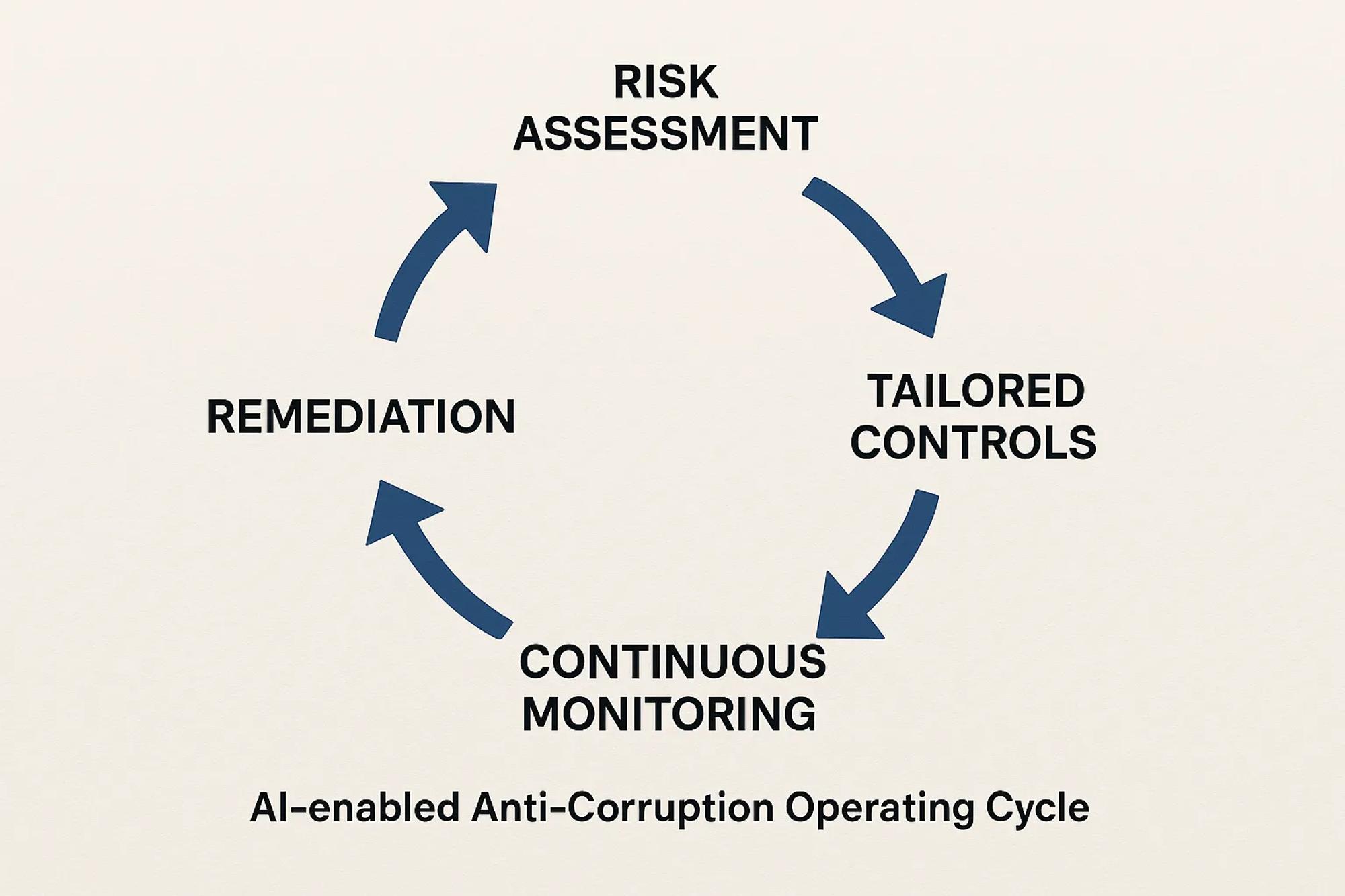
- Faster: generate a corruption risk assessment in days, not weeks. Naltilia accelerates the regulatory compliance risk assessment by ingesting your organizational footprint, sectors, counterparties, and transaction patterns to propose an auditable risk map and heatmap for review.
- Smarter: receive tailored controls, policies, and training plans aligned with your exposure by geography, business model, and processes, and consistent with ISO 37001 and Sapin II expectations.
- Stronger: continuously monitor the effectiveness of controls. AI highlights anomalies in gifts and hospitality registers, flags missing approvals, and detects early signs of deterioration in third-party risk or control execution.
- More accessible: automate evidence collection and workflow. Naltilia centralizes attestations, approvals, and control tests, assigns owners, and tracks remediation actions so smaller teams can scale impact without adding headcount.
This is compliance that works in the background so your team can focus on human work, including ethical leadership, judgment, investigations, and building a culture of integrity.
How Naltilia fits your control environment
- Regulatory risk assessment: structured scoping by country, function, and third-party type, with documented assumptions and sources for audit trails.
- Tailor-made policies: AI-assisted drafting of anti-bribery policy, gifts and hospitality rules, conflicts of interest disclosures, and charitable contributions guidelines, adapted to local thresholds and languages for review and approval.
- Compliance workflow automation: tasking, reminders, and escalation for control testing, certifications, and remediation actions.
- Automated control testing: monitoring effectiveness of control in real environments.
Human oversight remains central. Naltilia is designed for human-in-the-loop review, transparent change logs, and exportable evidence packs to align with audit and regulator expectations.
A practical 60-day plan to raise anti-corruption maturity
Even with limited resources, mid-sized enterprises can make measurable progress quickly.
- Days 1 to 10: establish the baseline. Confirm scope, business units, and jurisdictions. Inventory third parties by risk category. Map touchpoints with public officials. Confirm ownership for gifts and hospitality, sponsorships, and charitable contributions. Align with related programs such as AML, antitrust (UNE 19603), and criminal compliance (UNE 19601) to avoid duplicate controls.
- Days 11 to 25: complete a risk map. Use AI to produce an initial heatmap with rationales, then validate with business owners. Prioritize top five risks and define clear acceptance criteria and KPIs, for example percentage of high-risk third parties with enhanced due diligence completed, timely gifts approvals, and training completion in exposed teams.
- Days 26 to 45: design or refresh controls. Update the code of conduct section on bribery, gifts, and conflicts. Deploy a consistent gifts and hospitality workflow. Define payment red flags and pre-approval thresholds. Implement third-party onboarding and periodic review checklists proportionate to risk.
- Days 46 to 60: activate monitoring and reporting. Automate evidence collection where possible. Set up a dashboard with trend lines, exceptions, and remediation status. Prepare a focused report for executive management that covers risk exposure, control effectiveness, and next steps.
The fight against corruption belongs to all of us
International Anti-Corruption Day is more than an awareness moment. It is a call to action for governments, companies, and individuals. Corruption grows in silence. Integrity grows through action. With AI, building and maintaining robust anti-corruption programs no longer has to be slow, painful, or reserved for only the most mature organizations. We now have the tools to make anti-corruption simpler, faster, more reliable, and accessible to all.
See how Naltilia can transform your anti-corruption program
If you want to discover how AI can dramatically simplify your anti-corruption processes, from risk assessment to continuous control monitoring, we would be delighted to show you.
Together, let us make integrity not just a principle, but a practice.