
December is a special month for organizations. Interactions multiply, professional relationships relax, and tokens of appreciation become more visible, from invitations and gift baskets to year‑end thank‑yous. These practices are part of business life and are often seen as harmless, sometimes even necessary for maintaining relationships.
From a compliance and anti‑corruption perspective, however, this period concentrates elevated risk. Not because intentions are always bad, but because a gift, by nature, creates a link. It can establish a sense of obligation, influence a decision, or simply create the appearance of an undue advantage. In matters of integrity, appearance often matters nearly as much as intent.
This is why gifts and hospitality are among the most monitored risks in anti‑corruption programs aligned with Loi Sapin II and ISO 37001. They sit at the boundary between social custom and undue advantage, between professional courtesy and a potential impairment of impartiality. That boundary is often more fragile than we think.

Why gifts and hospitality increase corruption risk
Gifts and invitations rarely look like a suitcase of cash. They are ordinary gestures, a dinner, an invitation to a match or a concert, a seasonal hamper, a personalized attention at Christmas. Risk rises as soon as the gesture is connected, directly or indirectly, to decision‑making power, for example supplier selection, contract renewal, licensing, inspections, subsidies, certifications or recommendations.
In these contexts a gift can tilt objectivity, create a feeling of indebtedness, weaken the independence of a current or future decision, or at the very least give the appearance of preferential treatment. That appearance alone can trigger legal, disciplinary or reputational exposure.
- See the U.S. Department of Justice FCPA Resource Guide for treatment of hospitality and promotional expenses and the central role of intent and context: FCPA Resource Guide.
- The UK Ministry of Justice guidance explains that hospitality that is reasonable and proportionate may be permissible, but thresholds, timing and approvals matter: Bribery Act 2010 guidance.
- The Agence Française Anticorruption stresses traceability, proportionality and frequency in its recommendations: Agence Française Anticorruption.
Myths that resurface every December
It is a small gift, it does not count. Value is only one factor. Context, frequency, role and timing are equally decisive under AFA and ISO 37001 expectations.
We should not offend a partner. A clear rule protects the relationship. Declining by pointing to the policy is usually better understood than an improvised refusal.
Everyone in our sector does this. Common practice does not reduce legal exposure. Enforcement actions routinely cite “industry norms” as part of the problem, not the solution.
It is just marketing. If it targets decision‑makers, occurs near a decision, or exceeds proportionality, it can still be an undue advantage.
Ten questions to ask before you accept or offer
Use this as a micro‑checklist during compliance risk management training and in day‑to‑day decisions, particularly in December.
- What is the real value of the gift or invitation? Consider market value and in‑kind benefits like VIP access, travel or accommodation.
- Is it compliant with our internal policy? Check thresholds, annual caps, absolute prohibitions and declaration or pre‑approval procedures.
- Am I in an exposed function? Procurement, sales, public functions, control, certification, subsidy, authorization or inspection roles are higher risk.
- Is there a live or upcoming decision involving the giver or recipient? Tender, renewal, inspection, audit or awaited decision.
- Is this a one‑off or part of a pattern? Frequency is a major risk indicator in AFA guidance.
- Is it individualized or broadly distributed? Targeted gifts are riskier than generic items given to all attendees.
- Is any explicit or implicit quid pro quo expected? Even unstated expectations like a favorable recommendation or faster processing raise risk.
- Is it proportionate to professional context and local custom? Disproportionate gestures are red flags and require case‑by‑case analysis.
- Is the situation traceable and declared? Ensure it is logged in the register and, if required, validated by management or compliance.
- Would I be comfortable if this were public? The publicity test remains a powerful way to objectify risk.
AFA practical rule. If any criterion is problematic, the situation must be refused, declared or escalated to management, the compliance function or the ethics officer. Doubt should never remain individual.
What counts as a gift or hospitality
Gifts include tangible items, experiences and advantages, for example physical goods, meals, tickets, travel and upgrades, event access, discounts, charitable donations requested by or tied to the recipient, internships or jobs for relatives, and speaking fees. Company swag of nominal value that is widely distributed is typically lower risk, provided it is not targeted at a decision maker during a decision window.
Item or situation | Typical risk level | Notes on context | Required action |
|---|---|---|---|
Modest lunch after a completed project | Low to medium | No pending decision, shared among several attendees | Declare if required, no quid pro quo |
Holiday hamper worth 50, sent to all client contacts | Medium | Frequency and audience matter, watch cumulative value | Record in register, monitor frequency |
VIP sports tickets with travel and hotel during an active RFP | High | Timing and value, direct link to decision maker | Decline, escalate to compliance |
Charitable donation to a foundation suggested by the official in charge of a license | High | Proxy gift, potential bribery of public official | Prohibit, escalate |
Repeated small gifts to the same person across the year | Medium to high | Cumulative effect can create obligation | Escalate for review, likely decline |
Training scenarios you can reuse this season
Use these ready to run scenarios in December briefings. Each one includes context, decision, concrete actions and safe wording employees can use. Adapt thresholds and approvals to your policy and local law, and always log outcomes in the register.
Scenario 1, VIP match during an active RFP (procurement)
Context, A procurement manager is offered two VIP tickets to a holiday match, with travel and one night hotel, while an RFP is in the evaluation phase.
Decision, decline and log. The invite targets a decision maker during a live decision window, with high value and individualized access.
Actions, Notify line manager and compliance, record details in the register, ask the supplier to redirect any seasonal gesture to a modest, broadly distributed item after the RFP closes.
What to say, “Thank you for the generous invitation. Our policy does not allow us to accept hospitality during active tenders. I will record your offer in our register. We are happy to reconnect after the process concludes.”
Evidence, Save the invitation, email response, and register entry. Note timing versus the RFP calendar.
Scenario 2, Hampers to a buying committee before renewal (sales)
Context, A sales team plans to send 60 value hampers to each named member of a buying committee six weeks before a contract renewal negotiation.
Decision, do not send targeted gifts during a decision window.
Actions, Replace with neutral educational content available to all stakeholders, or a modest, broadly distributed token after the renewal is finalized. If any outreach occurs now, keep it factual and non promotional, and log the decision and rationale.
What to say, “To stay aligned with our gifts policy during renewals, we are pausing individual gifts. We would be glad to offer a short briefing for your team on next year’s roadmap, open to all attendees.”
Evidence, Document the original plan, the change in approach, and any alternative activity delivered.
Scenario 3, Recurring lunches for an auditor (quality or certification)
Context, A supplier offers to host lunch every quarter when the company’s quality auditor visits their site.
Decision, frequency plus exposed role creates heightened risk.
Actions, Set a cap and rotate hosting to avoid a pattern, or decline and suggest coffee on site, or reimburse equally if a working meal is necessary. Update the audit plan to include a note on hospitality boundaries.
What to say, “Appreciate your hospitality. To keep independence clear, we either split or we will host on our corporate card. I will note this in our register.”
Evidence, Keep receipts, meeting agenda, and a short note in the register that explains the approach.
Scenario 4, Third‑party funded travel to a user conference (partners)
Context, A technology partner offers to pay travel and hotel for an overseas user conference where one of your employees will present.
Decision, if attendance is legitimate and benefits the company, costs should be borne by the employer.
Actions, Decline third‑party travel funding, assess internal budget, obtain pre approval if needed, and document the business rationale for attendance. If the partner insists, convert support into a general sponsorship not linked to individual attendees and treat under marketing spend with approval.
What to say, “Our policy requires that we fund employee travel to conferences. We can explore a general sponsorship that is not tied to individual benefits.”
Evidence, Save the invite, approval chain, and final payment proof.
Scenario 5, Charitable donation suggested by a licensing official (public sector)
Context, A local official informally suggests that a donation to a named foundation would help smooth a pending license.
Decision, prohibit, escalate immediately.
Actions, Decline, inform compliance and legal, record the interaction with date, participants and wording, and apply the most restrictive rule for public officials. Do not process any donation linked to an official’s request or to a live decision.
What to say, “We cannot make donations connected to licensing decisions. Our policy and the law prohibit this. We will continue through the standard process.”
Evidence, Detailed note of the interaction, escalation email, and any follow up.
Scenario 6, Event raffles and high‑value prizes at a trade show
Context, Marketing proposes a booth raffle for premium headphones open to procurement leaders from key accounts.
Decision, avoid targeted high value prizes linked to exposed roles, particularly where sales opportunities are live.
Actions, If a giveaway is necessary, choose a modest, broadly distributed item with no link to specific deals, or run a knowledge quiz open to all attendees with low value swag. Publish rules, use a random draw, and avoid collecting personal data that targets decision makers during tenders.
What to say, “To remain compliant, we will switch to a modest, general giveaway available to all visitors. No individual targeting during tenders.”
Evidence, Keep the approved mechanics, prize list, and attendee communications.
Scenario 7, Digital gifts and e‑vouchers after a webinar
Context, After a December webinar, the team wants to send 25 value e‑vouchers to selected attendees who asked questions.
Decision, treat vouchers as gifts, higher risk if targeted or near decisions, and often prohibited for public officials.
Actions, Replace with non cash recognition, for example a certificate, access to a technical whitepaper, or an invitation to a public training session. If vouchers are used in permissible contexts, apply thresholds, distribute broadly, and pre approve. Always record recipients and rationale.
What to say, “We do not provide vouchers to individual attendees. We will share the slides and a follow up clinic open to all.”
Evidence, Recipient list if any, approval, and register entries.
Scenario 8, Travel upgrades offered by an airline vendor during renewal
Context, Your travel manager is offered complimentary lounge access and upgrades for personal holiday travel while the corporate travel contract is up for renewal.
Decision, decline, value is personal and the timing links to a contract decision.
Actions, Thank and refuse the perk, document and escalate to compliance, confirm that only contracted corporate benefits apply. Rotate decision makers if needed to avoid any influence.
What to say, “I cannot accept personal travel perks during a renewal. Please keep our benefits to the contracted corporate program.”
Evidence, Screenshots or emails, plus the renewal calendar.
Scenario 9, Internship request for a relative from a supplier during a tender
Context, A supplier asks if your team can find a holiday internship for their niece while their bid is under review.
Decision, treat as an improper advantage, decline and escalate.
Actions, Reply that all internships follow the standard HR process, no exceptions, and pause the interaction during the tender. Inform the bid committee and compliance.
What to say, “Internships are managed by HR through open postings. We cannot discuss referrals linked to active tenders.”
Evidence, Email trail, HR policy reference, and register entry.
Scenario 10, Cross border holiday gifts with different local customs
Context, Regional teams in two countries want to send customary year end gifts. Local practice in one market expects higher value items.
Decision, apply the stricter of company policy and local law, and avoid gifts near live decisions.
Actions, Standardize the gesture across markets at a modest level, use company branded items distributed broadly, and require pre approval for any exceptions. Train teams to consult the matrix of public official rules by country.
What to say, “We will align to the stricter threshold and avoid targeted gifts. Let us switch to a branded item, same for all contacts, after open decisions.”
Evidence, Approval memo, recipient list, and invoices with unit values.
Micro drills to reinforce judgment
Use quick prompts at the end of a session to test understanding, keep these fast and practical.
- Is the recipient involved in a live decision, yes or no, if yes, decline or escalate.
- Is the item targeted to a person or broadly distributed, if targeted, apply stricter rules.
- Would I be comfortable if this appeared on our website tomorrow, if not, stop and escalate.
Facilitator tips for a 30 minute workshop
- Pick three scenarios that match your highest risk functions and run them as role plays, one minute to read, two minutes to decide, one minute to state the response.
- Always end with the same operational steps, check timing and role, apply thresholds, pre approve if needed, record in the register, communicate politely.
- Capture real examples from the group, add them to your training library, and circulate outcomes so people see consistent decisions.
Public officials and regulated contexts
Rules are typically stricter for interactions with public officials. Many jurisdictions prohibit gifts to public officials outright, or allow only minimal, widely distributed items. The FCPA and similar laws reach non‑U.S. government officials abroad, and enforcement often focuses on travel, hospitality and charitable contributions linked to official acts. Local administrative rules can be even tighter for licensing or inspection authorities. Train teams to ask, am I dealing with a public official, and if so, apply the most restrictive rule.
Operating controls that reduce December risk
- Re‑communicate policy clearly, emphasize thresholds, absolute prohibitions, declaration and pre‑approval steps, and process for refusals.
- Open an ethics question channel, encourage “ask before, not after,” and commit to fast turnaround during the holidays.
- Maintain a gifts and hospitality register, ensure entries include value, giver or recipient, context, frequency and approvals. The register protects people and decisions.
- Focus training on exposed functions, including procurement, sales, operations, certifications and anyone interacting with authorities.
- Brief suppliers and partners, share your policy and set expectations in writing in master agreements and tender documents.
For deeper guidance on building your underlying anti‑bribery framework, see our explainers on compliance under Loi Sapin II and on risk assessment methodology for ISO 37001.
Evidence, auditability and continuous improvement
Auditors and regulators will look for both design and effectiveness. In practice, that means your policy, registers and approvals exist, people know the rules, exceptions are handled consistently, and you can show that decisions were made and recorded on time.
If you need to improve how evidence is captured across the year, our guide on automating evidence collection for controls outlines practical patterns that raise response rates and keep your records audit‑ready.
Technology that makes training and approvals stick
Compliance teams rarely have spare bandwidth in December. This is where an AI‑enabled platform can help by standardizing your process and keeping a clean trail, for example centralizing your policy and thresholds, guiding users through short risk questions, automating data collection for the register, routing approvals for exposed scenarios, and generating reminders and simple dashboards for managers. Naltilia provides regulatory risk assessment, remediation workflows, tailor‑made policies, automated data collection and compliance workflow automation that help teams apply the same rule every time and prove it later.
A one‑page checklist for employees
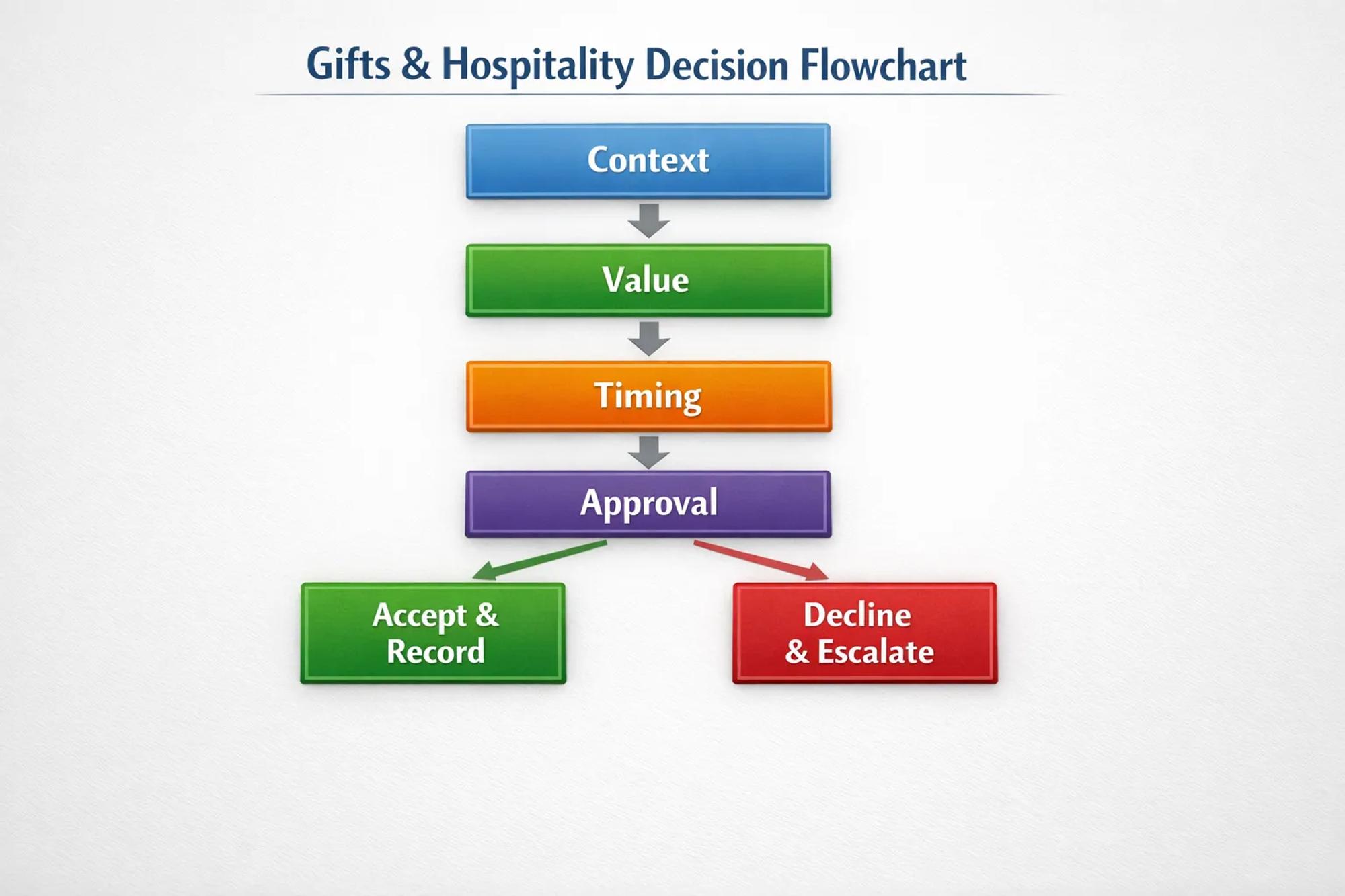
When you receive a gift or invitation:
- Check timing and role, is a decision live or am I in an exposed function.
- Estimate real value, include travel, upgrades or VIP access.
- Apply the policy, thresholds, caps, prohibitions and pre‑approval rules.
- Log it, enter the register before accepting where required.
- Decide, accept, decline or escalate based on the 10 questions.
- Communicate politely, reference the policy when declining.
When you plan to offer a gift or hospitality:
- Confirm purpose, legitimate business rationale and proportionate value.
- Screen the recipient, public official rules are stricter, often prohibitive.
- Avoid decision windows, never offer during tenders, renewals or inspections.
- Prefer broadly distributed, modest items over targeted, high‑value perks.
- Get pre‑approval where required and record the expense transparently.
- Share your policy with partners and keep invoices and attendee lists.
The key point to remember
A year‑end gift is never entirely neutral when you hold decision power. This is not about suspicion of people, it is about protecting decisions, the organization, and colleagues acting in good faith. Clear rules, consistent training, a reliable register and fast escalation routes turn a high‑risk month into routine, controlled business. If you want to operationalize this at scale, explore how Naltilia’s AI can help standardize policies, automate risk questions and approvals, and keep a defensible record while your teams stay focused on the work that matters.
Further reading on anti‑corruption, risk mapping and program design is available on our blog, including how to build a compliance risk map in 6 steps and our note for International Anti‑Corruption Day.