
Hire a compliance consultant when independence, specialist expertise, or credibility with a regulator is decisive: a first Sapin II or ISO 37001 program, an investigation or dawn raid, a certification or customer audit within 120 days, or expansion into a new jurisdiction. Keep accountability, risk decisions, and evidence ownership in house. Use technology for the recurring work, data collection, monitoring, evidence trails, so consultant hours go to judgment, not administration.
If you lead compliance in a company, there will be moments when external help is not a luxury but a risk reducer. The challenge is knowing exactly when to bring in a compliance consultant, what to keep in house, and where technology can replace recurring consultant hours without sacrificing quality.
This guide offers a practical decision framework anchored in common regulatory situations across Loi Sapin II and ISO 37001, antitrust programs, criminal compliance. It is written for compliance officers and in house counsel who need to scale without losing control.
When you definitely need outside help
You do not need a compliance consultant for every policy refresh or routine risk review. You do need outside support when independence, specialist expertise, or credibility with regulators becomes decisive.
Enforcement now has teeth: the AFA's first fines
On 9 July 2026, the AFA's sanctions commission issued its first pecuniary sanctions since the Sapin II law entered into force: €350,000 against a company and €60,000 against its president, personally. The message for compliance leaders is direct — an anti-corruption program that has never been independently reviewed is now a quantifiable personal risk for executives, not just a corporate one. If your program has not been benchmarked against Article 17 since before this decision, an independent review moved from "good practice" to "urgent." Read our full analysis of what the 9 July 2026 decision changes for your anti-corruption program.
New or expanded obligations with hard deadlines
- Loi Sapin II or ISO 37001, if your French parent or customers expect Article 17 grade anti corruption programs or certification, a compliance consultant helps calibrate risk mapping and prepare defensible evidence for AFA inquiries or certification audits. The French Anti Corruption Agency’s recommendations set clear expectations for effectiveness, not paperwork, see AFA guidance.
- UNE 19601 or UNE 19603 in Spain, if you pursue certification or face sector scrutiny, a compliance consultant familiar with Spanish enforcement practice can align your program with Article 31 bis Penal Code and CNMC expectations. For context on upcoming antitrust guidance, see our note on the CNMC’s update consultation.
Investigations, dawn raids and privileged reviews
When you face a whistleblowing allegation with potential criminal or antitrust exposure, or a dawn raid by a competition authority, outside counsel and forensic specialists provide independence and privilege. They also help structure remediation so it is creditable with authorities. The US Department of Justice’s guidance on evaluating corporate compliance programs remains a useful benchmark for remediation credibility, see the DOJ’s evaluation framework.
High stakes certifications and customer assurance
Large RFPs frequently require evidence of anti bribery controls, third party due diligence, and competition compliance training coverage. An independent program review or pre certification gap analysis can be the difference between a pass and a costly rework. A compliance consultant brings external comparators and audit style documentation discipline.
Cross border expansion or M&A
New countries, distributors and joint ventures multiply corruption and competition risks. A compliance consultant accelerates risk scoping, third party segmentation and integration playbooks, especially where you lack local language and regulatory context.
Resource pinch with immovable deadlines
If you have a small team and face a 60 to 120 day window to deliver a risk map, a policy suite and a training rollout, co sourcing with a compliance consultant helps you hit the date. Use outside help where judgment is scarce, and use technology for data collection and workflows.
What to keep in house, what to outsource
Strong companies retain accountability and decision rights. Use a compliance consultant to lift specialist work and to enhance credibility, not to replace the compliance function.
Activity | Keep in house | Co source with a compliance consultant |
|---|---|---|
Tone at the top, governance, disciplinary decisions | Yes | No |
Obligations inventory, regulatory mapping | Own catalogue, use a platform | Methodology calibration for new frameworks |
Risk assessment for corruption, antitrust, criminal compliance, AML, AI Act | Own risk model, automate data collection | Expert review for first cycle or major refresh |
Policy framework and code of conduct | Own ownership and sign off | Templates and localization for Sapin II, ISO 37001, UNE standards |
Third party due diligence design | Own risk tiers and decisions | Model design and red flag playbooks |
Training plan and business adoption | Own rollout, metrics, refresh cadence | Scenario design for antitrust, high risk roles |
Investigations on sensitive matters | Direct oversight | Strategy and protocols |
Certification readiness, internal audits | Own remediation tracking | Pre assessment and mock audits |
Control monitoring and evidence | Own indicators, use automation | Exception taxonomy and sampling approach |
How to scope and manage a compliance consultant without losing control
- Set outcomes, not activities. Define the decision you must make or the external assurance you must pass. Examples, a risk register approved by the board, an antitrust training coverage above a defined threshold, a mock audit with residual risk documented.
- Fix the RACI up front. Compliance owns standards and sign offs, business units own risk and controls, a compliance consultant facilitates and provides expert judgment, technology provides data and evidence.
- Demand knowledge transfer. Include deliverables such as a playbook, a data dictionary, and a handover workshop, not only slideware.
- Require a defensible methodology. Ask a compliance consultant to map methods to relevant frameworks and to cite sources used for scoring and controls.
- Protect data and privilege. For sensitive matters, route through counsel, mark work product appropriately, and set data retention rules.
- Insist on tech enablement. Wherever possible, a compliance consultant should feed structured outputs into your platform so you can maintain them without a retainer.
The hybrid model that saves budget and speeds outcomes
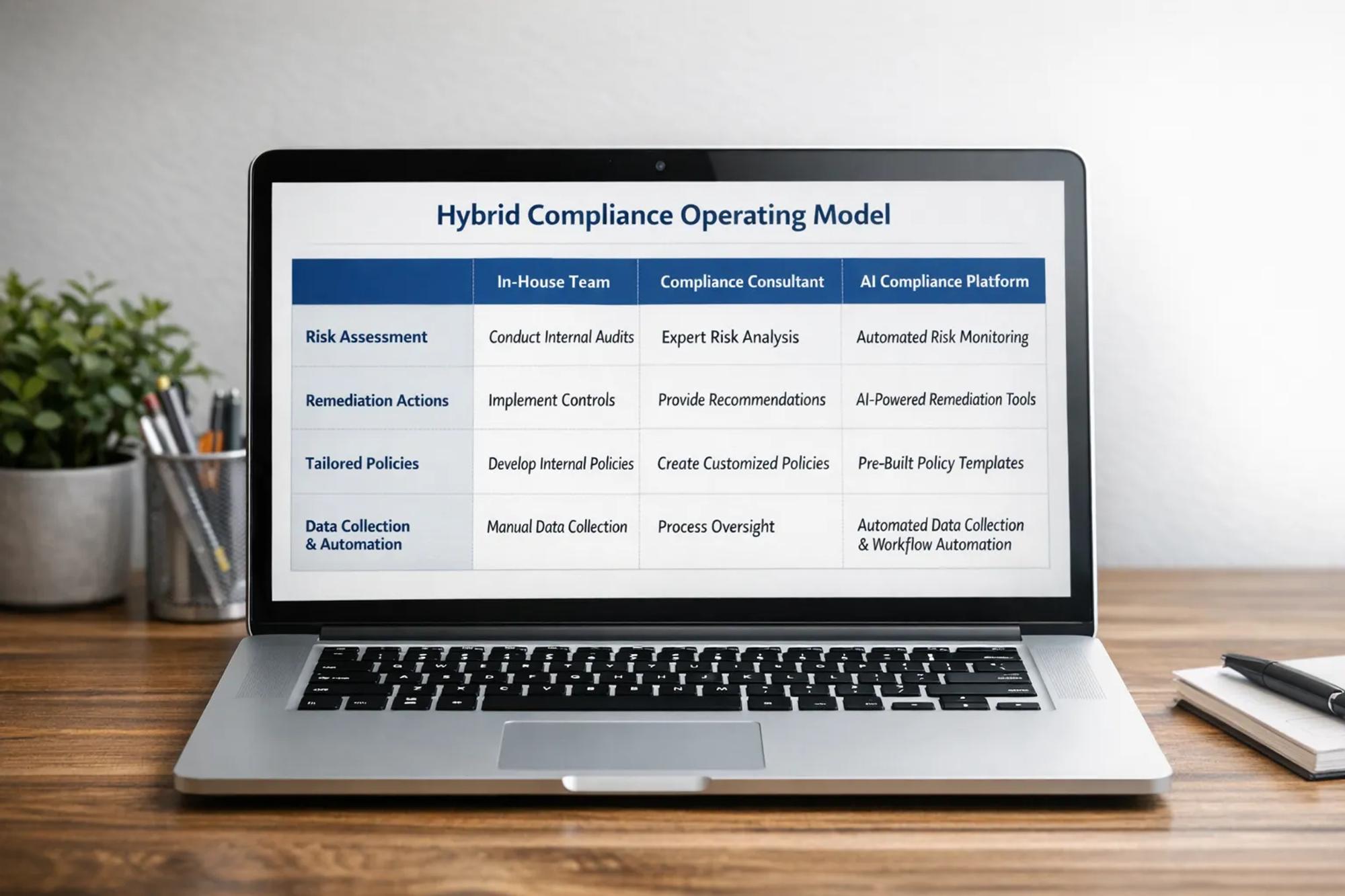
The efficient path for mid-size teams is a hybrid model. Use targeted consultant hours for design, calibration and independent review, then let an AI powered platform run the recurring work so you keep momentum without buying more hours every quarter.
Naltilia’s platform helps you do exactly that by automating the parts that repeat and documenting the parts that regulators review:
- Regulatory risk assessment, centralize your inventory of obligations and operationalize a living risk map, including anti corruption, antitrust, criminal compliance in Spain, AML and AI governance.
- Remediation actions, assign owners, due dates and track closure with an auditable trail.
- Tailor made policies, generate and maintain policies aligned to your risk profile, with clear ownership and versioning.
- Automated data collection, replace email chases with structured evidence capture and system data pulls when possible.
- Compliance workflow automation, standardize approvals, attestations and exception handling so you can demonstrate effectiveness.
The result, you reserve a compliance consultant for high judgement and independence, and you run day to day compliance at scale with fewer bottlenecks. For a practical example of hybrid delivery on evidence and monitoring, see our guide on automating evidence collection and our control monitoring case study.

Signals you can likely handle internally with the right platform
Not every gap needs consulting. If you see these signals, consider platform first before calling for outside help:
- You already know your obligation set, but your risk register is stale because data collection is manual.
- Your remediation backlog is long because assignments and due dates live in spreadsheets.
- Policies exist, but version control, acknowledgements and role targeting are inconsistent.
- Control owners provide evidence via email and shared drives, which makes audits slow and brittle.
In these cases, automation improves accuracy and speed, and it generates the evidence trail that auditors and authorities expect. For step by step methods, see our articles on risk mapping in six steps and on building a program auditors trust.
Common pitfalls and how to avoid them
- Paper compliance creep, avoid deliverables that look good on paper but have no adoption or monitoring. Ask for implementation milestones and metrics.
- Over outsourcing, a compliance consultant can design, but your team must own decisions and evidence. Keep sign offs and risk ownership in house.
- Tool last, if you wait until after the consultant project to select a platform, you will pay again to operationalize the outputs. Bring your platform into scope on day one.
- Undefined success, vague Statement of Works (SOW) produce vague results. Tie fees and timelines to concrete outcomes and regulator ready evidence.
Quick self test, do you need a compliance consultant now
Answer yes to two or more, and it is time to scope outside help:
- We face a regulator, a certification body or a customer audit within 120 days.
- We are entering a new jurisdiction or launching a business model with new obligations.
- We have a material allegation or incident that could interest authorities.
- Our program has never been independently reviewed against Sapin II, ISO 37001, UNE 19601 or UNE 19603.
- Our AI roadmap includes systems that may be high risk under the AI Act.
- Our team does not have bandwidth to deliver within the required time.
For broader context on sizing cost and benefits before you engage, read our analysis of the cost and benefit of compliance and why avoiding paper compliance matters with modern regulators.
Ready to scale your program with fewer consultant hours and stronger evidence, see how Naltilia automates regulatory risk assessment, remediation actions, tailor made policies, automated data collection and compliance workflow automation. Book a short discovery call at Naltilia.
Frequently Asked Questions
Are compliance consultants the same as external auditors or certification bodies?
No, compliance consultants advise and help implement, while auditors and certification bodies assess independently. For certification schemes like ISO 37001 the assessor must be independent of program design.
What is the biggest mistake companies make when hiring a compliance consultant?
Outsourcing accountability. Keep ownership of risk decisions, controls and evidence, and require knowledge transfer so you can operate without perpetual support.
Should we use a compliance consultant for our first AI Act assessment?
If you operate or plan high risk systems, external support helps translate legal requirements into engineering and product practices. Pair that with a platform to operationalize documentation, oversight and updates.
How often should we commission an independent program review?
Many mid sized companies do a review every one to two years, or after major changes such as acquisitions, entering regulated markets, or material incidents.
When is external counsel preferable to a compliance consultant?
When you need legal privilege, for example during sensitive investigations or when preparing for potential enforcement actions.
Can technology replace a compliance consultant entirely?
No, technology scales recurring work, risk data and evidence. A compliance consultant adds judgment, independence and credibility. The best outcomes combine both.